Omamori: How Japanese Amulets Work and How to Treat Them
You've seen the little silk pouches dangling from school bags in anime. Here's what's inside, why you shouldn't open one, and what to do with it after a year.
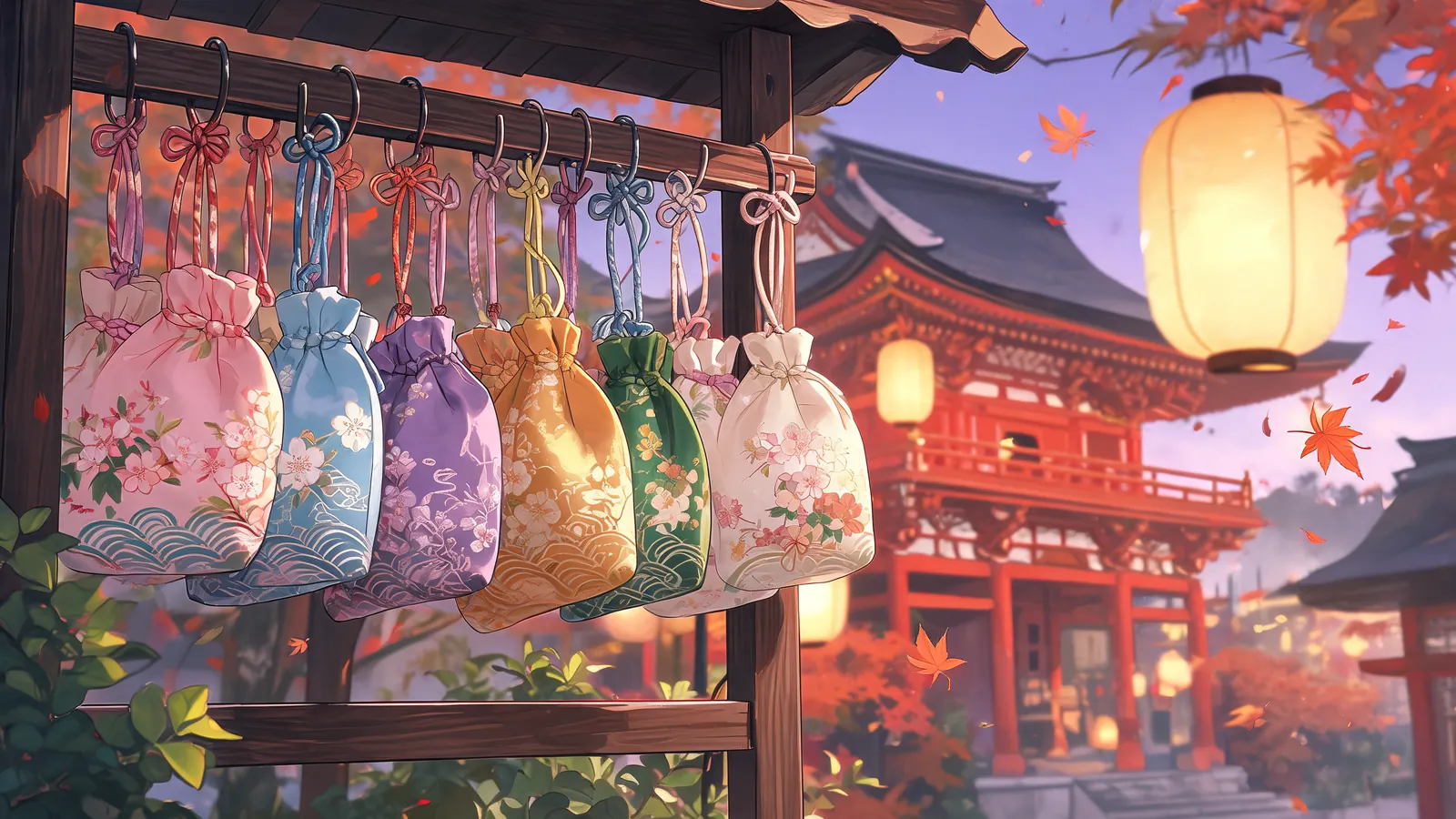
In anime they hang from school bags, swing from the rear-view mirror of a taxi, or get pressed into someone's hand before an exam. In Japan you can hardly walk a hundred meters without seeing one. An omamori (お守り) looks like a small decorative pouch, and that's exactly why most people outside Japan treat it like a souvenir. In Japan it's treated a bit more carefully.
What the word means
Mamoru means to protect, and omamori is, quite literally, "a protection," with the polite prefix o. Shrines and temples both give them out. At a Shintō shrine the omamori carries the power of the kami of that shrine. At a Buddhist temple it carries the power of a buddha, bodhisattva or protective being, often written as a Sanskrit seed syllable in the old Siddham script (Bonji in Japanese).
A small detail of language tells you a lot. In Japanese you don't really "buy" an omamori. You "receive" it, sazukaru, and the money you hand over is called an offering rather than a price. That's not just politeness. It reflects the idea that what you take home has been blessed and isn't a product.
What's inside
The brocade pouch is only the wrapping. Inside is usually a small slip of paper or a thin piece of wood with the name of the shrine or temple, the name of the kami or buddha, or a short prayer. It has been consecrated in a rite before it's given out. In other words, the omamori is a small, portable version of the larger paper talismans, the ofuda, that people keep at home. I write more about those in the article on ofuda.
And that's why you shouldn't open it. Opening an omamori is considered disrespectful, and many people believe that the protection leaves once the inner slip is exposed. Put simply, you'd be opening a sealed letter that wasn't addressed to you. If you're curious anyway, there are plenty of photos online. Your own one is better left closed.
The different kinds
Most shrines and temples offer a whole range, each one for a particular area of life. The name is usually embroidered on the front:
- Kōtsū anzen (交通安全), safety on the road. The one you see hanging in cars.
- Gakugyō jōju (学業成就), success in studies and exams. Very popular at shrines of Tenjin, the deified scholar Sugawara no Michizane.
- En-musubi (縁結び), tying good bonds, mostly understood as love and finding a partner.
- Anzan (安産), a safe birth.
- Yakuyoke (厄除け), warding off misfortune, especially in the "unlucky years" of life, the yakudoshi.
- Shōbai hanjō (商売繁盛), a thriving business. Inari shrines are the classic place for this one.
- Kenkō (健康), good health, often linked at temples with the Medicine Buddha, Yakushi Nyorai.
It isn't magic in the sense of a guarantee. Japanese people would describe it more as a reminder and a support. You carry the blessing with you, and it keeps the wish present in your mind.
Your birth-year buddha
Here's a detail from esoteric Buddhism that most visitors never notice. Many Shingon temples offer omamori for your personal protective buddha, the mamori honzon (守り本尊), which depends on the zodiac animal of your birth year. The traditional assignment goes like this:
| Birth year | Protective buddha or bodhisattva |
|---|---|
| Rat | Senju Kannon, the thousand-armed bodhisattva of compassion |
| Ox, Tiger | Kokūzō Bosatsu, the bodhisattva of boundless wisdom |
| Hare | Monju Bosatsu, the bodhisattva of insight |
| Dragon, Snake | Fugen Bosatsu, the bodhisattva of practice |
| Horse | Seishi Bosatsu, the bodhisattva of the power of wisdom |
| Ram, Monkey | Dainichi Nyorai, the great sun buddha |
| Rooster | Fudō Myōō, the immovable wisdom king and great protector |
| Dog, Boar | Amida Nyorai, the buddha of infinite light |
Yes, you read that right: the same twelve animals that Naruto turned into hand signs also decide which buddha watches over you. I explain the zodiac side in the article on Naruto's hand signs.
How to treat an omamori
There are no strict rules, but there are good customs:
- Keep it with you or near the thing it protects, in your bag, your wallet, your car or at your desk.
- Keep it clean and off the floor. It's a blessed object.
- Don't open it. See above.
- Several are fine. You can carry omamori from different shrines and temples at the same time.
- Giving one as a gift is fine, and very common for exams, births and travel.
What to do after a year
The usual custom is to keep an omamori for about a year, or until the wish has come true. Then you bring it back, ideally to the place where you received it, and say thank you. Most shrines and temples have a box for returned omamori and ofuda. Around New Year and in mid-January, many of them burn the old ones in a large purification fire, in many regions called dondo-yaki, and the blessing goes back to where it came from. Throwing an omamori in the trash is the one thing you really shouldn't do.
If you can't get back to Japan, some shrines and temples accept returns by post, so it's worth checking their website. A shrine omamori traditionally goes back to a shrine and a temple omamori to a temple.
Do you have an omamori somewhere at home, and do you remember where it came from?
The Energy Between Your Hands
If you're interested in the protective side of the Japanese tradition, leave your email. You'll get a short practice from the Japanese tradition as a free PDF, and a few letters from me about the real tradition behind the anime.
Free. Unsubscribe anytime. Privacy policy
Quick answers
What is inside an omamori?
Usually a small slip of paper or wood with the name of the shrine or temple, the kami or buddha, or a short prayer. It has been blessed in a rite, and the brocade pouch protects it.
Can I open my omamori?
Traditionally, no. Opening it is considered disrespectful, and many people believe the protection leaves when the inner slip is exposed.
How long does an omamori last?
The usual custom is about a year, or until the wish it was for has come true. After that it is returned to a shrine or temple with thanks and burned in a purification fire.
Can I have several omamori from different shrines?
Yes. Most priests will tell you this is fine. The old joke that the kami get jealous of each other is just that, a joke.
Is it okay for a non-Japanese person to have an omamori?
Yes. Shrines and temples give omamori to anyone who asks. Treating it with a little respect is all that's expected.
Sources and further reading
- Jinja Honchō (Association of Shinto Shrines), information on omamori and ofuda.
- Ian Reader and George J. Tanabe Jr., Practically Religious: Worldly Benefits and the Common Religion of Japan, University of Hawai'i Press, 1998.

Dr. Mark Hosak
Japanologist with a PhD from Heidelberg University and about three years of research at Kyoto University on Buddhist art, architecture and ritual. Shingon practitioner and researcher, successor of Taguchi Sensei in his line of Ninjutsu, author of books on Reiki and its Japanese roots. He walked all 88 temples of the Shikoku pilgrimage on foot.