Onmyōdō and Abe no Seimei: Japan's Real Yin-Yang Masters
You've seen onmyoji throw paper charms in Onmyoji, Twin Star Exorcists and countless games. The real ones worked for the imperial government, kept the calendar and were paid to keep demons out of the capital.
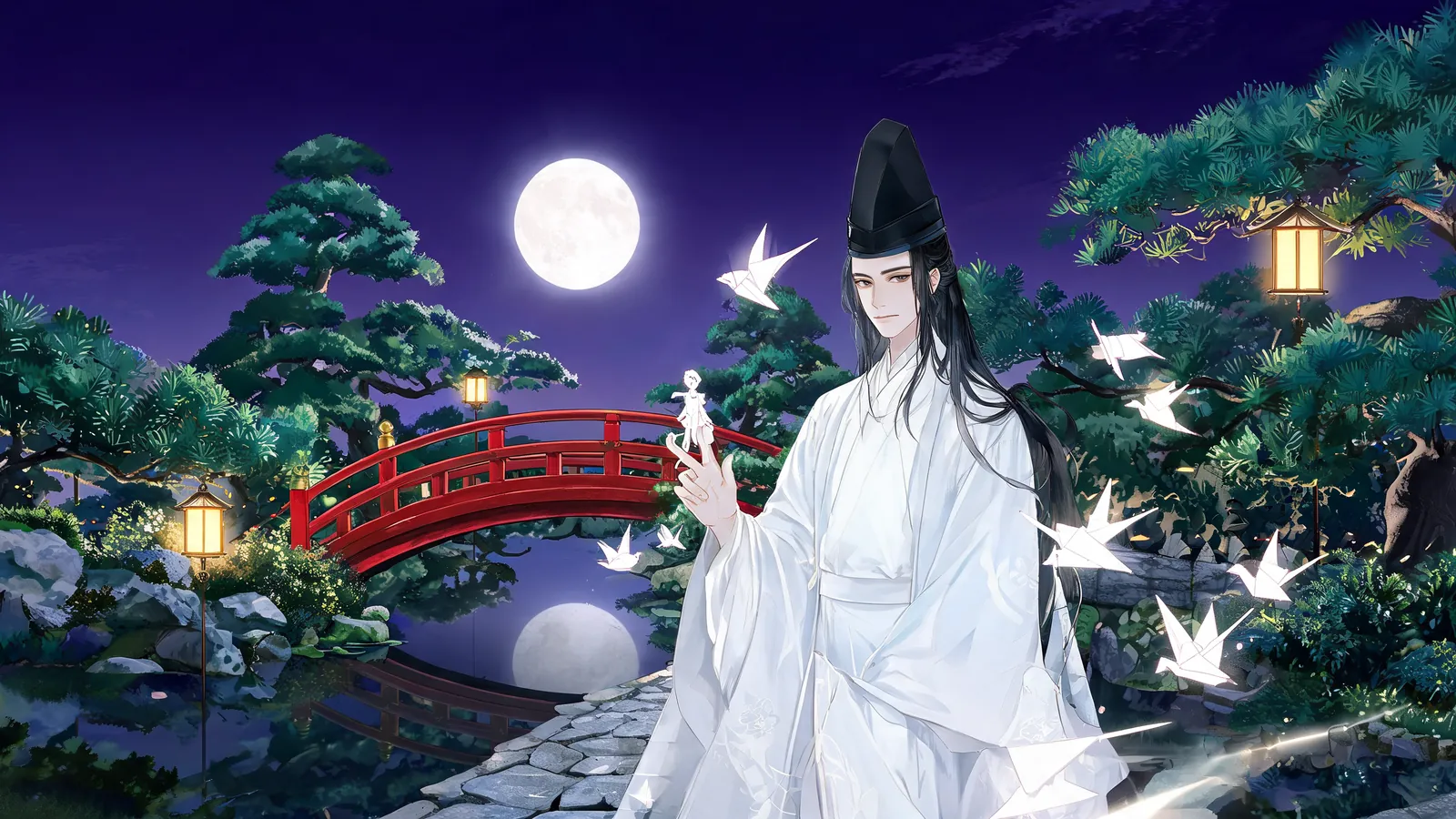
If an anime has a calm young man in white court robes and a tall black hat who throws paper charms at demons, you're looking at an onmyōji. The image is so popular that most fans don't realize the job really existed. For several centuries it was a position in the Japanese government, with a salary, a job description and an office.
The way of yin and yang
Onmyōdō (陰陽道) means the way of yin and yang. It grew out of Chinese cosmology: the interplay of yin and yang, the five phases of wood, fire, earth, metal and water, the calendar, astronomy and the art of reading signs. Daoist knowledge came to Japan by the seventh century at the latest. The Nihon Shoki, the chronicle completed in 720, opens its account of creation with yin and yang.
When Japan built its state on the Chinese model around the year 700, it created a special office for all this, the Onmyōryō (陰陽寮), the bureau of yin and yang. Its staff kept the calendar, watched the sky, kept time with a water clock and practiced divination. In other words, they did astronomy, timekeeping and fortune-telling for the state, and nobody at the time saw any contradiction in that.
In the Heian period, the high point of court culture between 794 and 1185, the onmyōji became indispensable. Courtiers asked them which days were safe to travel, in which direction they could not go, when to stay at home behind closed doors because of bad omens, and how to protect a house from bad influences. The northeast was considered the "demon gate," kimon, and both Kyoto and its great temples were laid out with that direction in mind. Protective rites, amulets and talismans were part of the work, too. I like to point out that this was also the time when Kūkai, who had studied in China, was building up esoteric Buddhism in Japan. The two traditions knew each other well, and they borrowed from each other.
Abe no Seimei, the man
The most famous onmyōji of all, Abe no Seimei (安倍晴明), lived from 921 to 1005. He was a real court official. He studied under the Kamo family, the leading onmyōdō family of the time, served several emperors, performed rites for the powerful Fujiwara regents and was still working in his eighties. His descendants, the Abe family, later known as Tsuchimikado, ran the bureau together with the Kamo for centuries.
That's the historical core, and it's fairly modest. What happened next is the interesting part. Within about a hundred years of his death, Seimei had turned into a legend.
Abe no Seimei, the legend
In the great tale collection Konjaku Monogatarishū, written down around 1120, there's a lovely story about his youth. As a boy, Seimei accompanies his master on a trip at night, and while the master sleeps in the carriage, the boy sees a procession of demons approaching. He wakes the master, who hides them both with a spell. From then on the master knew this boy could see what others couldn't.
Other stories have Seimei kill a frog from a distance with a blade of grass, see through a rival's tricks, and command shikigami (式神), spirit helpers bound to him. One later legend says he kept his shikigami hidden under the Ichijō Modori bridge in Kyoto, because his wife was frightened of them at home. That detail always makes me smile. Even the greatest magician of Japan had to make some concessions to domestic peace.
The paper figures that come alive, which you see in every anime, are the popular modern face of the shikigami idea. I wouldn't call them wrong. They're simply the most visual version of an old belief that a trained person can bind and command spirits.
The fox mother
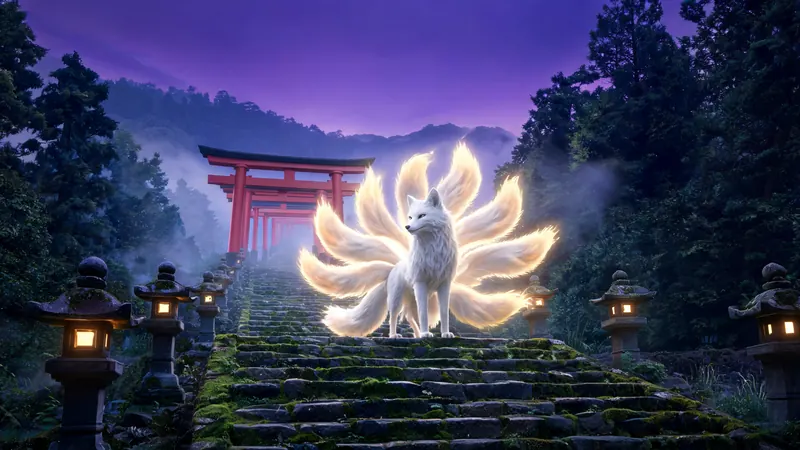
Then there's the most famous legend of all. In the Edo period, puppet theater and kabuki told that Seimei's mother was a white fox named Kuzunoha. She had taken human form out of gratitude, married his father and lived happily with him until her son, still a small child, saw her true form. She had to leave, and wrote a farewell poem telling them to look for her in the forest of Shinoda. A small Kuzunoha shrine still stands in that forest, in Izumi south of Osaka. If you'd like to know more about foxes, I've written about the nine-tailed fox and the Inari faith.
Seiman and dōman
Seimei's emblem is a five-pointed star, the Seimei kikyō or seiman, drawn in one line. It stands for the five phases. His legendary rival was Ashiya Dōman, and a grid of lines is named after him, the dōman. The women divers of Ise-Shima still mark their clothing and tools with both signs for protection at sea. The grid is a close relative of the grid of the nine seals, which I explain in the article on Kuji Kiri.
Why Seimei is everywhere now
The Meiji government closed the bureau of yin and yang in 1870, and onmyōdō lost its official role. The modern Seimei boom started much later, with a series of novels by Yumemakura Baku from the 1980s, followed by a manga adaptation, two feature films starring the kyōgen actor Nomura Mansai, a hit mobile game and, more recently, a Netflix anime. Fiction picked up exactly where the old tale collections left off.
Where onmyōdō still lives today
- Seimei Shrine, Kyoto. Founded in 1007, two years after his death, on the site of his residence. The pentagram is everywhere, on lanterns, roof tiles and amulets. A small replica of the Ichijō Modori bridge stands in the grounds.
- Abe Ōji Shrine, Osaka. One of the places that claim to be his birthplace.
- Shinoda forest, Izumi. The Kuzunoha shrine of the fox mother.
- Ōi, Fukui Prefecture. A Shintō group that carries on the tradition of the Tsuchimikado line is based there today.
- Setsubun. The custom of eating a sushi roll while facing the year's lucky direction, ehō, comes out of the same world of directions and calendars.
If you could ask Abe no Seimei a single question, what would it be?
The Japanese Grimoire Society
In the Japanese Grimoire Society we look at Japan's magical traditions with the original sources at hand, and at the practice that grew out of them. You can start with a free trial and look around.
Have a look insideQuick answers
What is onmyōdō?
Onmyōdō (陰陽道), the way of yin and yang, is a Japanese tradition of divination, calendar science, astronomy and protective ritual. It grew out of Chinese yin-yang and five-phase thought and was run by a government bureau at the imperial court from the late seventh century until 1870.
Was Abe no Seimei a real person?
Yes. Abe no Seimei lived from 921 to 1005 and served the Heian court as an onmyōji. Within a century of his death he had become a legendary figure in tale collections such as the Konjaku Monogatarishū.
What is a shikigami?
In the legends, a shikigami (式神) is a spirit helper bound to and commanded by an onmyōji. The famous image of paper figures turning into living helpers is a later and especially popular form of the idea.
What does the star at Seimei Shrine mean?
The five-pointed star, called Seimei kikyō or seiman, stands for the five phases of yin-yang thought: wood, fire, earth, metal and water. It is the emblem of Seimei Shrine in Kyoto and is used as a protective sign.
Sources and further reading
- Konjaku Monogatarishū (c. 1120), tales about Abe no Seimei.
- Japanese Journal of Religious Studies 40/1 (2013), special issue "Onmyōdō in Japanese History."
- Mark Hosak, section on Daoism in Japan in The Big Book of Reiki Symbols: The Spiritual Transition of Symbols and Mantras of the Usui System of Natural Healing (Lotus Press).
- Seimei Shrine (Seimei Jinja), Kyoto, official information.

Dr. Mark Hosak
Japanologist with a PhD from Heidelberg University and about three years of research at Kyoto University on Buddhist art, architecture and ritual. Shingon practitioner and researcher, successor of Taguchi Sensei in his line of Ninjutsu, author of books on Reiki and its Japanese roots. He walked all 88 temples of the Shikoku pilgrimage on foot.