Kuji Kiri: The Nine Hand Seals and Where They Really Come From
You've seen ninjas flash their fingers before a jutsu. Behind that gesture is a nine-character formula that traveled from China to Japan and turned into something you only find in Japan.
Nine characters, nine hand positions, a few seconds of finger work, and then something happens. That's how most of us first met Kuji Kiri, on a screen, usually just before a ninja did something impossible. The funny thing is that the screen version gets one part right. In Japan the nine seals really were supposed to make things happen. What they were supposed to do, and where they came from, is a much longer story.
The nine characters
Here they are, in the order you'll find them in most Japanese sources:
Read as an ordinary Chinese sentence, the line says something like: face the enemy, the warriors fight, all of them stand in front and break through the ranks. It sounds like a battle cry, and that's how it is often translated.
My own take is that the sentence is a disguise. Each character is the sound of a mantra, and the nine were put together so that they also make sense as a sentence. Someone who isn't initiated reads a war slogan. Someone who is initiated reads a memory aid for a ritual, nine sounds, each tied to a hand seal and to a being who works through it. I can't prove that this was the plan of whoever first strung the nine together, but it fits the way esoteric traditions in East Asia like to hide things in plain sight.
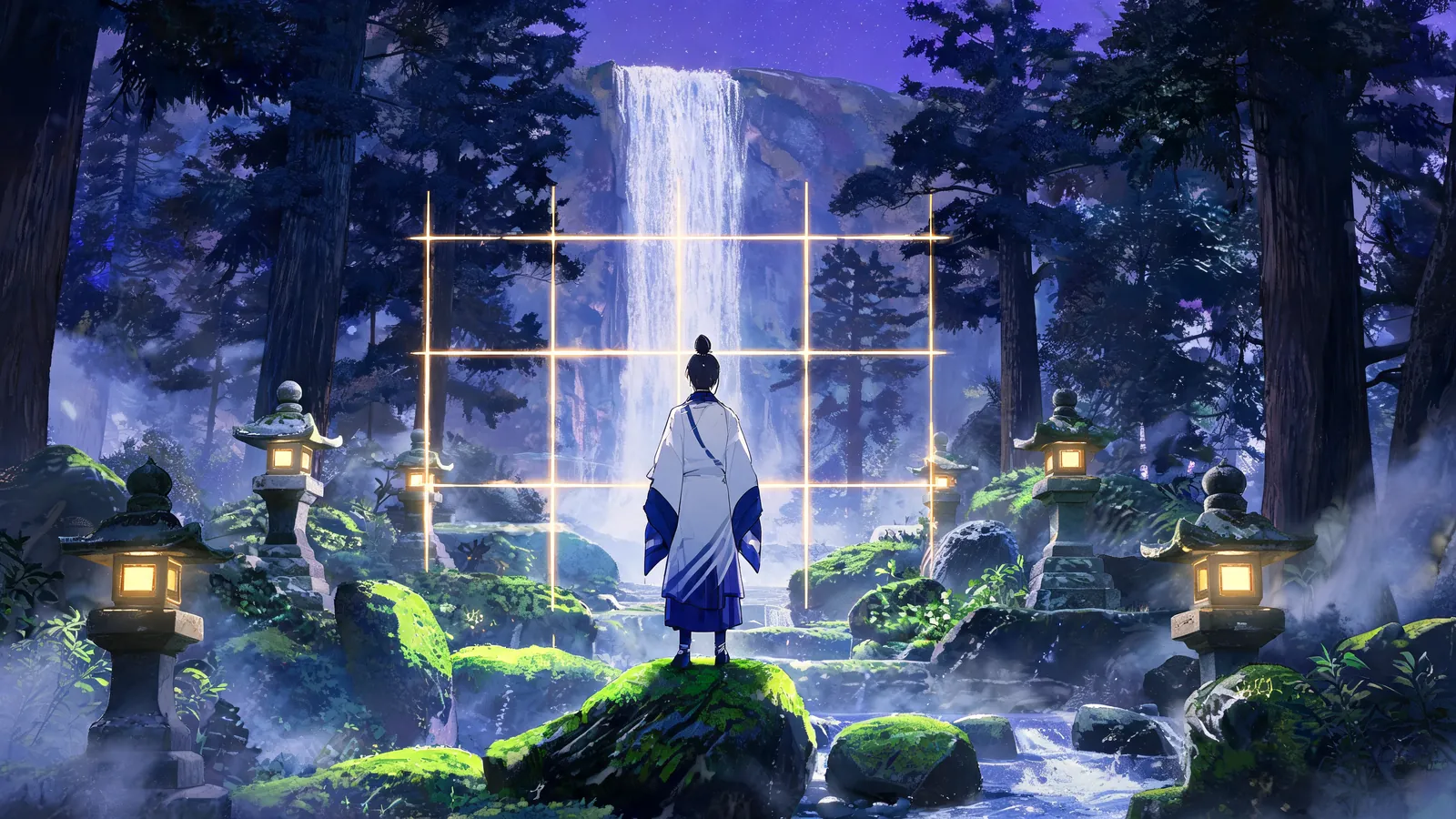
The two names you'll see are often mixed up. Kuji-in (九字印) means the seals of the nine characters, in other words the nine mudras made with the hands. Kuji Kiri (九字切り) means cutting the nine characters, which refers to drawing a grid of lines in the air. The older and more formal name for the whole practice is Kuji goshin hō (九字護身法), the protective method of the nine characters. Put simply, it was a way of protecting yourself and a place, and it was taken very seriously.
From China to Japan, in several waves
The earliest sources for the nine characters come from China, from the world of Daoist protective magic. There they were used as a spell to keep danger away, for example when you went into the mountains, which in those days was a genuinely risky thing to do.
The usual story you read online jumps straight from one old Chinese book to the ninja. That's too short. What actually happened is less tidy and more interesting. The material came to Japan in several waves over the centuries, through the constant exchange of monks, scholars and texts between Japan and the mainland. And once it was in Japan, people kept working on it, again for centuries.
Here I'd like to explain a cultural principle that helps with almost everything on this site. In Japan the old is rarely thrown away when something new arrives. It lives on next to it and, over time, blends with it. That's exactly what happened to the nine characters. Daoist spell, Japanese folk magic and the esoteric Buddhism of Shingon (mikkyō) grew together. The mountain ascetics of Shugendō, the yamabushi, carried the practice into the mountains and into village life, and it stayed closely tied to Shintō and its kami. The result is a system that exists in this form only in Japan. Calling it Chinese, or simply Buddhist, misses most of what makes it Japanese.
In many Japanese lineages each of the nine is linked to a buddha, bodhisattva, wisdom king or protective being. The lists differ from lineage to lineage, which is normal for a practice that was handed down in many separate lines. One figure who almost always stands close to the nine seals is the Immovable Wisdom King Fudō Myōō, a great protector in Shingon and Tendai who looks fierce but is deeply kind, with his sword that cuts through what doesn't serve you and his rope that pulls you back to safety. Marishiten, a protective being of light whom samurai liked very much, is another one you meet again and again.
Dates for the Kuji Kiri live events and the Kuji Kiri Master Path are on the Kuji Kiri page of shingon-reiki.com. If you'd rather start at home, there's the Kuji Kiri Level 1 Online Course.
How the ninja got involved
Ninjutsu lines did take over Kuji Kiri, and that's how the practice became famous in the twentieth century, first through ninja films and novels, then through manga and anime. The mountain ascetics and the ninja lived in the same kind of terrain and, by many accounts, knew each other well. So it isn't surprising that the nine seals turned up in both worlds.
For me it's a bit of both. I'm a Shingon practitioner and researcher, and I'm also the successor of Taguchi Sensei, a Ninjutsu grandmaster in Osaka, in his line. So I meet the nine seals in the temple and in the dojo. During my research in Kyoto I had the chance to take part in esoteric rituals and to do ascetic practice with mountain ascetics and high-ranking monks in the forests. And when I walked the Shikoku pilgrimage, the mantra of Fudō Myōō was something I relied on. I often climbed into ice-cold mountain streams, the kind you can normally stand for a few seconds, and with that mantra I could stay in for a long time. That's my experience, and I don't expect anyone to take it as proof of anything.
Where you can still see the nine seals today
You don't have to go looking for secret scrolls. In Japan the nine characters are surprisingly visible once you know what you're looking at.
- With the yamabushi. Shugendō is alive, for example on the three mountains of Dewa Sanzan in Yamagata and in the Ōmine range south of Nara. Mountain ascetics still use the nine characters in their rituals.
- On temple talismans. Some temples issue protective paper talismans, ofuda, and amulets that carry the nine characters or the grid. I write more about those in the article on ofuda.
- With the ama divers of Ise-Shima. The women who dive for shellfish in Mie Prefecture traditionally mark their clothing and tools with two protective symbols, a five-pointed star called seiman and a lattice called dōman. The lattice is a close relative of the Kuji grid. The names point to the court diviners of onmyōdō, which I cover in the article on Abe no Seimei.
- In martial arts. Several traditional lines, ninjutsu among them, still keep the nine seals as part of their spiritual side.
What the nine seals were for
The short answer is protection. The longer answer is that protection, in this tradition, starts on the inside. The three areas of body, speech and mind are worked on together: the hands form the seal, the voice speaks the sound, and the mind holds an image. Each of the nine has its own quality, and together they were used to clear away what had settled on a person or a place.
The deepest layer, in my view, has less to do with keeping enemies away and more to do with fear. A person who is free of fear can act from the heart, and that's what makes protecting others possible in the first place. In plain terms, the nine seals were a way of becoming steady. The anime version with exploding fireballs is a lot more fun to watch, of course.
How the seals are actually formed, in which order the sounds are spoken and what you hold in mind for each one, I'm deliberately leaving out here. That part has always been passed on in person, and a page on the internet would only give you the outer shape.
If you've seen the hand signs in anime, which series was it for you?
The Japanese Grimoire Society
The practice of the nine seals is passed on in person, and that's what the Japanese Grimoire Society is for: the sources, the background of each seal and the spirits behind them, in a group that takes this seriously. You can start with a free trial and just look around.
Have a look insideQuick answers
What is the difference between Kuji-in and Kuji Kiri?
Kuji-in (九字印) refers to the nine hand seals, the mudras. Kuji Kiri (九字切り) means cutting the nine characters, the ritual of drawing a grid of lines in the air. In practice the two belong together, and the full practice is often called Kuji goshin hō, the protective method of the nine characters.
Does Kuji Kiri come from China?
The earliest sources come from China. Over the centuries the material reached Japan in several waves and was developed further for centuries more, until it became a system that only exists in Japan, combining Daoism, Japanese folk magic and Shingon esoteric Buddhism, carried by Shugendō and tied to Shintō.
Is Kuji Kiri a ninja technique?
It is best known through ninja stories and martial arts, but it is much older and much broader than that. It belongs to esoteric Buddhism, Shugendō and Japanese folk religion, and ninjutsu lines took it over from there.
Can I learn Kuji Kiri from a video?
You can learn a lot about its history and meaning from reading and watching. The practice itself has always been passed on in person, from someone who carries it to someone who receives it.
Sources and further reading
- David Waterhouse, "Notes on the kuji," in P. F. Kornicki and I. J. McMullen (eds.), Religion in Japan: Arrows to Heaven and Earth, Cambridge University Press, 1996.
- Mark Hosak, chapter on Kuji kiri in The Big Book of Reiki Symbols: The Spiritual Transition of Symbols and Mantras of the Usui System of Natural Healing (Lotus Press).
- Japan Tourism Agency, multilingual commentary database: Ama (Female Diver), on the seiman and dōman symbols.
Dr. Mark Hosak
Japanologist with a PhD from Heidelberg University and about three years of research at Kyoto University on Buddhist art, architecture and ritual. Shingon practitioner and researcher, successor of Taguchi Sensei in his line of Ninjutsu, author of books on Reiki and its Japanese roots. He walked all 88 temples of the Shikoku pilgrimage on foot.