Jujutsu Kaisen's Domain Expansion Hand Signs and the Real Mudras Behind Them
You've seen Gojo cross his fingers and the world turns into infinity. Fans have matched the domain hand signs to real mudras of esoteric Buddhism. Here's who those mudras actually belong to.
Jujutsu Kaisen is unusually generous with Buddhist detail. The characters fight with cursed energy, sorcerers seal curses in shrines, and at the climax of a battle someone forms a hand sign and opens a Domain Expansion, ryōiki tenkai (領域展開). Fans quickly noticed that several of these hand signs look like real mudras from Japanese temples, and they went looking for the originals.
I'd like to say one thing clearly before we start. The matches below come from fans. As far as I know, Gege Akutami hasn't confirmed which mudra stands behind which domain. What I can do is tell you who those mudras belong to in real Japanese practice, because that part isn't fan theory at all.
First, what a mudra is in Japan
In the esoteric Buddhism of Japan, mikkyō, a mudra is called in (印), a seal. Every buddha, bodhisattva, wisdom king and protective being has its own seal, its own mantra and its own symbol, often a Sanskrit seed syllable in the old Siddham script (Bonji in Japanese). The practitioner works with all three at once. The hands form the seal, the voice speaks the mantra, the mind holds the image. Shingon calls this the three mysteries, sanmitsu (三密), of body, speech and mind.
Put simply, a mudra is a little like a telephone number. Each one connects you to a particular being. That's why the idea behind Domain Expansion, a sign with the hands that opens a whole world, feels so right to anyone who knows this tradition.
The word jujutsu itself is worth a look, too. 呪術 is the ordinary Japanese word for magic or sorcery. The first character, ju (呪), can mean a curse, which is how the series uses it. In Buddhist texts the same character also stands for a spell or mantra, the kind you recite for protection. Same character, two directions.
Gojo and Taishakuten
Gojo Satoru's sign for Infinite Void, Muryōkūsho, is the one fans match to the mudra of Taishakuten (帝釈天). Taishakuten is the Japanese name of Indra, the old Indian king of the gods, who came to Japan with Buddhism as a protector of the teaching.
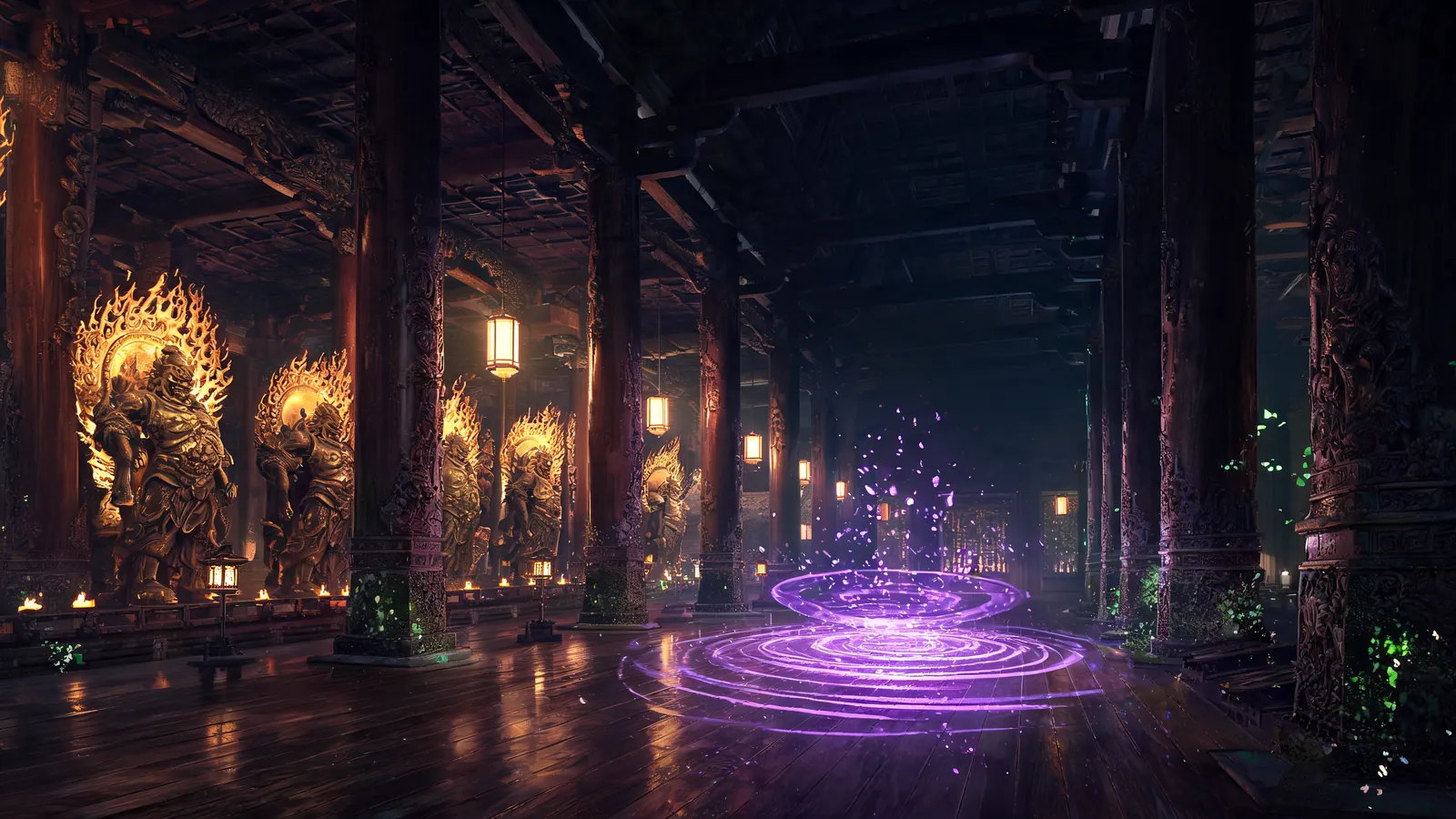
In esoteric Buddhism he belongs to the Twelve Devas, jūniten (十二天), who guard the directions of space around the sacred center. Taishakuten guards the east. If you want to see him, go to Tō-ji in Kyoto, the temple Kūkai received from the emperor in the early ninth century. In its lecture hall, among twenty-one statues set up as a three-dimensional mandala, Taishakuten rides a white elephant. Among Japanese visitors he has the reputation of being the most handsome statue in the hall. Gojo fans will not be surprised.
Sukuna and Enmaten
Sukuna's sign for Malevolent Shrine is linked by fans to the mudra of Enmaten (焔摩天), another of the Twelve Devas, the guardian of the south. Enmaten is Yama, the Indian lord of the dead. In popular Japanese belief he became Enma Daiō, the judge of the underworld who weighs your deeds after death, and you can find his fierce red face in small Enma halls all over Japan.
The name of the domain is interesting too. Fukuma mizushi (伏魔御廚子) contains zushi, the word for the small cabinet-shrine in which a sacred image is kept in a temple. A demon-subduing shrine, in other words. Fittingly ironic for the King of Curses.
The real Ryōmen Sukuna
This is where the series reaches deepest into Japanese history. Ryōmen Sukuna appears in the Nihon Shoki, the chronicle completed in 720. Under the reign of Emperor Nintoku it describes a being from Hida, the mountainous region of today's Gifu Prefecture, with one body and two faces looking in opposite directions, four arms and four legs, who wielded swords and bows and defied the court until a general was sent to kill him.
In Hida itself the story is told very differently. There Sukuna is remembered as a local hero, a dragon slayer, and in Buddhist legend as someone who spread the Lotus Sūtra in the region. At Senkōji, a mountain temple near Takayama, he is honored to this day, and the temple keeps a statue of him carved by Enkū, the wandering monk of the seventeenth century famous for his rough, smiling wooden buddhas. I find it fascinating that the same figure is a rebel monster in the capital's chronicle and a protector in the mountains. Which version you hear depends on who's telling it.
Megumi, Jogo and Mahito
Fans have matched a few more signs. Megumi's Chimera Shadow Garden is linked to a mudra of Yakushi Nyorai (薬師如来), the Medicine Buddha, who holds a small medicine jar in his left hand and is worshipped all over Japan for health and long life. Jogo's sign is linked to Daikokuten, a dark protective being from India who in Japan turned into a smiling god of good fortune with a sack of rice. Mahito's two signs are linked to a buddha mudra and to Kujaku Myōō (孔雀明王), the Peacock Wisdom King, who rides a peacock because peacocks were believed to eat poisonous snakes and so came to stand for overcoming poison of every kind.
Whether all of these matches hold up, I'd leave open. Some hand positions in the series are simplified for drawing, and many real mudras look alike to an untrained eye. The beings, though, are all very real and very much alive in Japanese temples.
Shingon Reiki Level 1 is a live event in English with five initiations, four Reiki initiations and the initiation into the Medicine Buddha. Details are on the booking page for Shingon Reiki Level 1.
Where you can meet these beings today
- Tō-ji, Kyoto. The lecture hall with its statue mandala, Taishakuten on his elephant included.
- Shingon and Tendai temples everywhere. Paintings and statues of the Twelve Devas are part of esoteric temple interiors, and the Medicine Buddha is one of the most common main images in Japan.
- Senkōji near Takayama. The two-faced Sukuna of Hida, as a protector rather than a villain.
- Small Enma halls. Look for a fierce red judge in a black cap. Japanese children are still told that Enma pulls out the tongues of liars.
In the series a hand sign works like a weapon, while in the temple it is meant to connect you with a particular being. I'm deliberately not describing how the real mudras are formed, because in this tradition they're passed on in person, together with the mantra and the meaning that make them work.
Which domain would you want to stand inside, if you had to pick one?
The Japanese Grimoire Society
In the Japanese Grimoire Society we look at the beings behind the mudras, the temples where you can meet them and the old sources, with people who love the series as much as you do. You can start with a free trial and look around.
Have a look insideQuick answers
Are the Jujutsu Kaisen domain hand signs real mudras?
Fans have matched several of them to real mudras of Japanese esoteric Buddhism, for example Gojo's sign to the mudra of Taishakuten and Sukuna's to the mudra of Enmaten. As far as I know the author has not confirmed these matches, but the beings themselves and their mudras are real and still part of temple practice in Japan.
Was Ryōmen Sukuna a real figure?
Ryōmen Sukuna appears in the Nihon Shoki, a Japanese chronicle completed in 720, as a being from Hida with two faces and four arms who defied the court. In Hida, today's Gifu Prefecture, local legends remember him as a hero, and the temple Senkōji in Takayama keeps a statue of him carved by the monk Enkū.
What does jujutsu mean?
The Japanese word jujutsu (呪術) means magic or sorcery in general. The first character, ju (呪), can mean a curse, but in Buddhist usage it also means a spell or mantra.
Sources and further reading
- Nihon Shoki (720), reign of Emperor Nintoku, entry on Ryōmen Sukuna of Hida; summary in Tokyo Weekender, Ryomen Sukuna: History in Japan.
- Overview of the fan comparisons: Anime Hunch, Domain Expansion Hand Signs Meaning (fan research, not confirmed by the author).
- On the Twelve Devas (jūniten) and the statues of the lecture hall of Tō-ji: Tō-ji temple information; Cynthea J. Bogel, With a Single Glance: Buddhist Icon and Early Mikkyō Vision, University of Washington Press, 2009.
Dr. Mark Hosak
Japanologist with a PhD from Heidelberg University and about three years of research at Kyoto University on Buddhist art, architecture and ritual. Shingon practitioner and researcher, successor of Taguchi Sensei in his line of Ninjutsu, author of books on Reiki and its Japanese roots. He walked all 88 temples of the Shikoku pilgrimage on foot.