Japanese Ghost Stories and Urban Legends, and What They Reveal
You've seen the long black hair and the white kimono in The Ring, and Hanako-san in a dozen school anime. Japan's ghosts have rules, a dress code and a favorite season, and almost all of them want something.
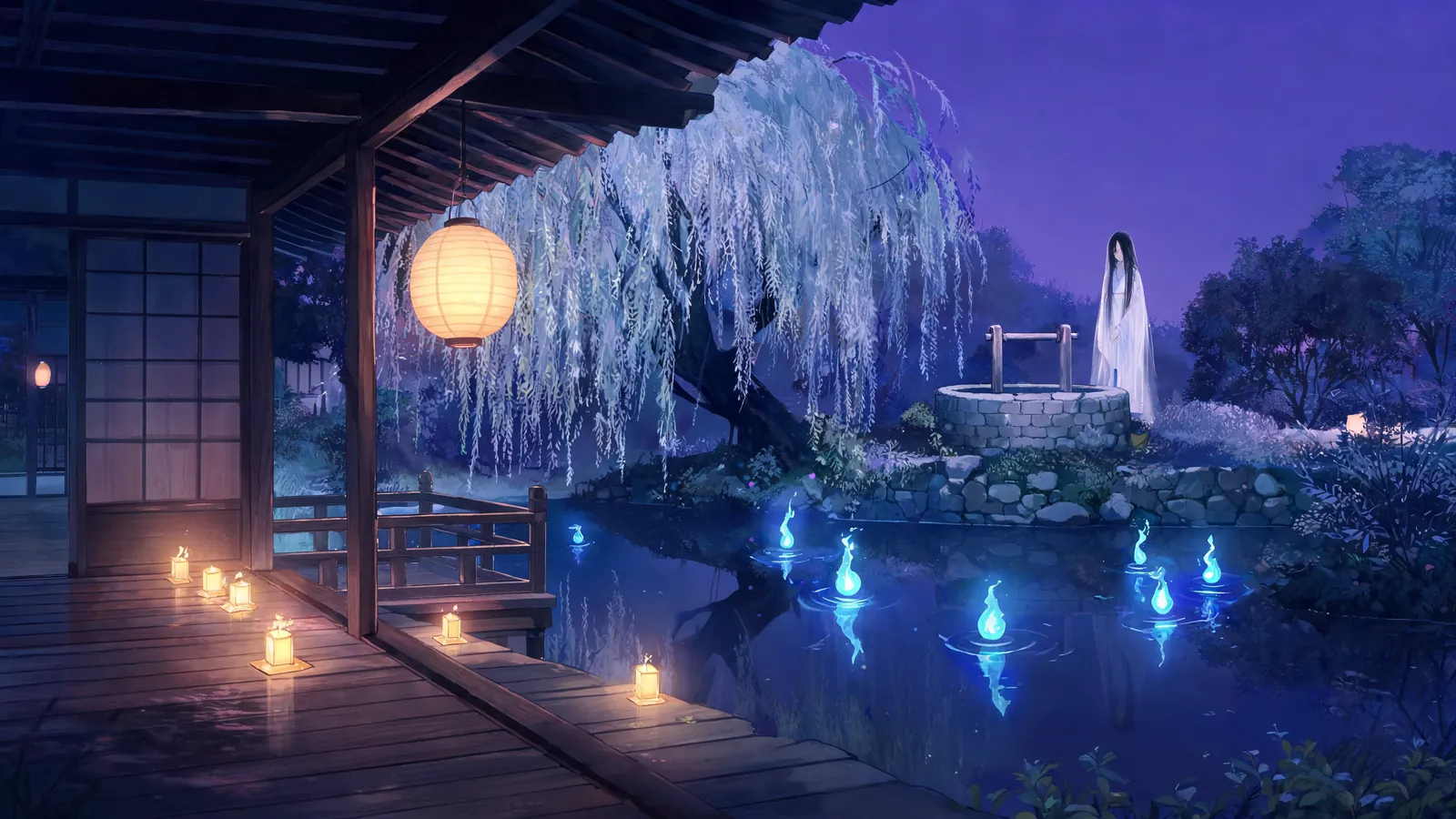
In Western films, ghosts mostly rattle chains and slam doors. In Japan they're quieter, and in a way more unsettling. They stand at the end of a corridor with their hair over their face. They count plates at the bottom of a well. They knock on a lover's door every night for weeks. And they nearly always have a reason to be there.
Yūrei, the dead who can't rest
Japanese distinguishes between yōkai, the whole world of strange beings, and yūrei (幽霊), the ghosts of the dead. The first character means faint or dim, the second a spirit. A yūrei is a person who died and couldn't move on, usually because of a violent or unjust death, a strong attachment, a deep grudge, or because the proper funeral rites were never performed.
This last point is important. In Japanese religion the living and the dead stay connected. Memorial rites, offerings at the household altar and the summer festival of Obon, when the ancestors are believed to come home for a few days, are ways of looking after the dead. A ghost, in this view, is someone who has fallen out of that care.
The dress code
By the Edo period, Japanese ghosts had a recognizable look, and it's still the one you see in horror films today:
- A white kimono. The white burial robe in which the dead were dressed.
- Long, loose black hair. Women wore their hair tied up in life, and it was let down for burial.
- A small white triangle on the forehead. A paper or cloth band placed on the dead.
- Hands hanging limply at the wrists, held in front of the body.
- No feet. The figure fades out below the waist. The painter Maruyama Ōkyo in the eighteenth century is often credited with making that image famous, and kabuki stages took it over.
- Floating spirit flames, hitodama, small blue-white fires drifting nearby.
The makers of The Ring didn't have to invent much. They put a very old ghost into a very modern television set.
The three great ghost stories
Oiwa and the Yotsuya Kaidan
In the kabuki play Tōkaidō Yotsuya Kaidan by Tsuruya Nanboku IV, first staged in 1825, the samurai Iemon betrays his wife Oiwa to marry into a richer family. A poison meant to get her out of the way disfigures her face, and she dies cursing him. Her ghost then destroys him, appearing in lanterns, in his new bride's face and even in the water. Actors who play Oiwa still visit her shrine in Tokyo before a production, just to be safe.
Okiku and the plate mansion
In Banchō Sarayashiki, a maid named Okiku is accused of losing one of ten precious plates and is thrown into a well. Every night afterward her voice is heard counting from the well, "one, two, three," up to nine, and then a terrible scream. Himeji Castle has a well that's still called Okiku's well.
The Peony Lantern
Botan Dōrō, based on a Chinese tale, is the gentlest and saddest of the three. A young samurai falls in love with a woman who visits him every night carrying a peony lantern. A neighbor peeks in and sees him embracing a skeleton. Protective talismans on the doors keep her out, until someone takes them down. It's a love story first and a horror story second.
When a ghost became a kami
The most powerful kind of ghost is the onryō, the vengeful spirit. Here Japanese religion did something remarkable. Instead of only fighting such spirits, it honored them. In 869 the court held a great rite in Kyoto to calm the angry spirits that were blamed for an epidemic, and that rite is counted among the origins of the Gion festival.
The most famous case is Sugawara no Michizane, a brilliant scholar and statesman who was falsely accused and died in exile in 903. Soon afterward lightning struck the palace, his enemies died one by one, and the capital was terrified. The court restored his honor and enshrined him as a kami, Tenjin. Today he is the kami of learning, and students pray to him before every exam. I come back to Tenjin in the article on Noragami. In Tokyo's financial district, the mound of the rebel warrior Taira no Masakado has been treated with great care for centuries, because stories of misfortune followed every attempt to move it.
Modern urban legends
The tradition didn't end with the Edo period. It moved to schools, trains and the internet.
- Kuchisake-onna. In 1979 rumors of a woman in a surgical mask who asks "Am I pretty?" before showing her slit mouth spread across Japan so fast that some schools sent children home in groups.
- Hanako-san. The girl who answers when you knock on the third stall of a school girls' bathroom and call her name. Every Japanese schoolchild knows the rules.
- Teke Teke. The upper half of a girl who died on train tracks, dragging herself along with her elbows at terrifying speed.
- Kisaragi Station. A train station that doesn't exist, first reported in 2004 on an online forum by a woman who said she was stranded there. Her posts simply stopped.
What the stories reveal
If you look closely, Japanese ghost stories are rarely random. Oiwa is a betrayed wife. Okiku is a servant punished for something that wasn't her fault. Michizane was an honest official destroyed by intrigue. The ghost returns where justice failed. I think that's why these stories are still told. They're frightening, but they're also a way of saying out loud that a wrong was done.
On summer nights in the Edo period, people played hyakumonogatari: a hundred candles, a hundred ghost stories, one candle out after each tale. When the last flame died, something was supposed to appear. Would you have stayed until the last candle?
The Energy Between Your Hands
If you like the uncanny side of Japan, leave your email and you'll hear about new articles. You'll also get a short practice from the Japanese tradition as a free PDF, a calmer counterpart to the ghost stories.
Free. Unsubscribe anytime. Privacy policy
Quick answers
What is a yūrei?
A yūrei (幽霊) is the ghost of a dead person who cannot rest, usually because of a violent death, a strong attachment or missing funeral rites. Yūrei are distinct from yōkai, the broader category of supernatural beings.
Why do Japanese ghosts have no feet?
From the Edo period onward, painters showed ghosts fading out below the waist. The painter Maruyama Ōkyo is often credited with popularizing the image, and kabuki adopted it.
Why are ghost stories told in summer in Japan?
Summer is the season of Obon, when the spirits of the dead are believed to return, and a good scare was said to give you a chill on hot nights. Kaidan theater, ghost films and storytelling events still peak in July and August.
What is hyakumonogatari?
An Edo-period game in which people lit a hundred candles and told ghost stories, putting out one candle after each tale. When the last light went out, something was supposed to appear.
Sources and further reading
- Zack Davisson, Yūrei: The Japanese Ghost, Chin Music Press, 2015.
- Michael Dylan Foster, The Book of Yōkai, University of California Press, 2015.
- Lafcadio Hearn, Kwaidan: Stories and Studies of Strange Things (1904).

Dr. Mark Hosak
Japanologist with a PhD from Heidelberg University and about three years of research at Kyoto University on Buddhist art, architecture and ritual. Shingon practitioner and researcher, successor of Taguchi Sensei in his line of Ninjutsu, author of books on Reiki and its Japanese roots. He walked all 88 temples of the Shikoku pilgrimage on foot.