Yokai List: 24 Japanese Spirits and What They Really Mean
You've seen them in Kitarō, Natsume's Book of Friends and a hundred other shows. Here's a field guide to the strange beings of Japan, where each one comes from and what people actually believed about it.
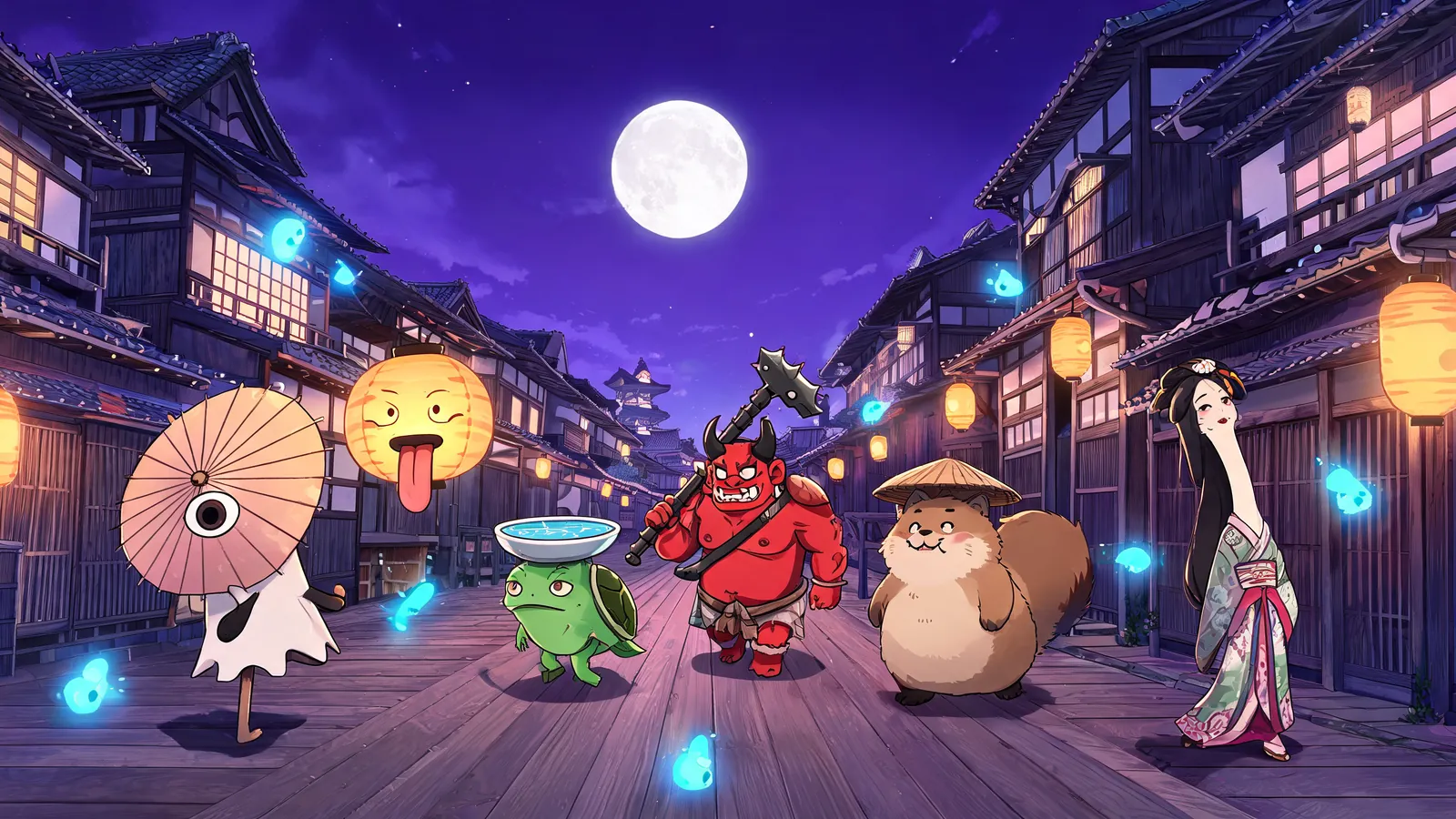
Japan has a word for everything that is odd, uncanny and hard to explain: yōkai (妖怪). The first character means something bewitching or suspicious, the second something strange. A fox that takes human shape is a yokai. So is an old umbrella that suddenly grows an eye, a long tongue and a single leg.
Two quick distinctions help. Yokai are not quite the same as yūrei, the ghosts of people who died with unfinished business, although the stories mix them freely. And they're not quite the same as kami, the powers worshipped at shrines. The folklorist Yanagita Kunio thought that many yokai were kami who had lost their worshippers, and that idea explains a lot. A being that was once honored and is now forgotten can turn unpredictable.
Most of the classic images go back to two sources. From the Muromachi period on, painters made scrolls of the "night parade of a hundred demons," hyakki yagyō (百鬼夜行), with whole processions of creatures and animated household objects. And in 1776 the artist Toriyama Sekien published the first of his illustrated yokai catalogues, which gave many of them the shape they still have today. In the twentieth century Mizuki Shigeru, the creator of GeGeGe no Kitarō, brought them back into every Japanese childhood.
Here are twenty-four of them, sorted roughly by where you'd meet them.
Animals that change shape
1. Kitsune · the fox
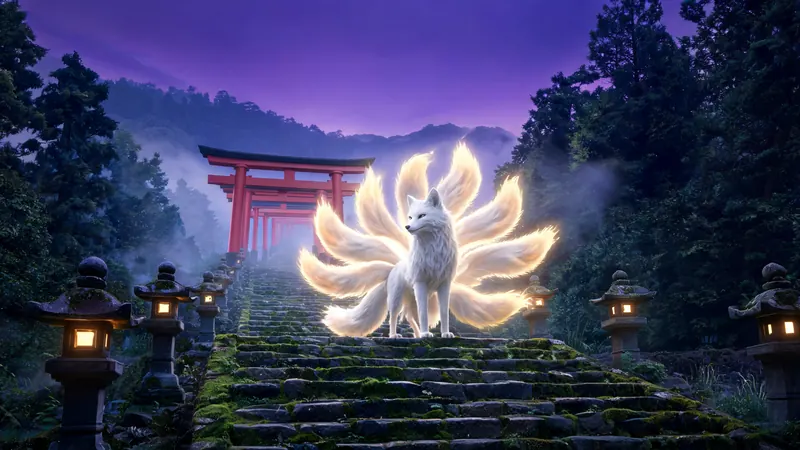
Clever, beautiful, gaining a tail with every century of its life. Some foxes serve the kami Inari as messengers, others are tricksters of the fields. The greatest of them has nine tails. I've written a whole article on the nine-tailed fox.
2. Tanuki · the raccoon dog
A real animal and a folklore shape-shifter at the same time. Tanuki like to fool people, preferably by putting a leaf on their head and turning into a teakettle, a monk or a pile of money that later becomes leaves again. The cheerful tanuki statues with straw hat, sake bottle and big belly, made in Shigaraki and placed outside restaurants all over Japan, are its friendly modern face.
3. Bakeneko and nekomata · the uncanny cat
A cat that lives too long may begin to walk on two legs, speak, or dance with a towel on its head. When its tail splits in two, it has become a nekomata. Edo-period kabuki loved monster-cat stories.
4. Jorōgumo · the spider woman
A spider that takes the form of a beautiful woman and lures men to a lonely place. Jōren Falls on the Izu Peninsula is one of the places tied to her legend.
Mountain and forest
5. Tengu · the mountain master
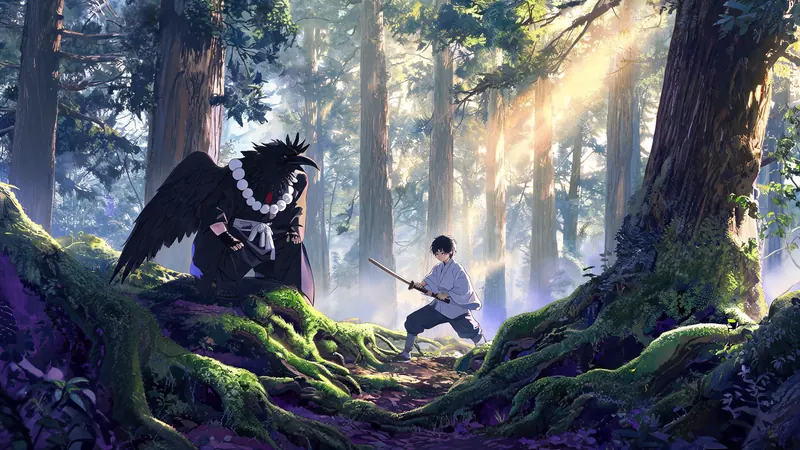
Bird-like or long-nosed, dressed like a mountain ascetic, proud and powerful. Once dangerous, later a protector of sacred mountains. More in the tengu article.
6. Yamauba · the mountain woman
A wild old woman of the mountains, sometimes a man-eater, sometimes a wise helper. In one famous version she raises the strong boy Kintarō, who grows up to become one of the heroes who defeat the demon Shuten-dōji.
7. Kamaitachi · the sickle weasel
Sudden cuts on the skin with no visible cause, especially in cold, windy regions, were explained by an invisible weasel with sickles for claws, sometimes said to travel in a group of three.
Water and sea
8. Kappa · the river imp
A small green creature with a beak, a shell on its back and a dish of water on top of its head. It pulls horses and children into rivers, but it is also extremely polite. Bow to it, it bows back, the water spills from its head and it loses its strength. Its favorite food is cucumber, which is why cucumber sushi rolls are called kappa maki.
9. Umibōzu · the sea monk
A huge dark shape with a round, bald head that rises out of a calm sea at night and can capsize boats.
10. Ningyo · the mermaid
Japan's fish-person is far less pretty than the European mermaid, and its flesh is said to grant extremely long life. In the legend of Yao Bikuni, a girl who ate it lived for eight hundred years.
11. Nure-onna · the wet woman
A being with a woman's head and a snake's body who appears on riverbanks and shores.
Demons and monsters
12. Oni · the demon
Horns, a tiger-skin loincloth and an iron club. The oni is Japan's classic demon, and every February people throw roasted soybeans to drive it out at the Setsubun festival. I explain where the horns and the tiger skin come from in the article on Demon Slayer.
13. Nue · the chimera
Monkey's face, raccoon dog's body, tiger's legs and a snake for a tail. According to the Tale of the Heike, the warrior Minamoto no Yorimasa shot one down from the roof of the imperial palace.
14. Tsuchigumo · the earth spider
A giant spider that the hero Minamoto no Raikō is said to have killed. Historians point out that "earth spider" was also an old insult for local groups who resisted the court.
Haunted objects
15. Tsukumogami · objects with a soul
A tool that has been used for a hundred years can come alive, and if it was thrown away carelessly it may come back angry. The idea is old, and medieval picture scrolls show discarded tools marching through the night for revenge. It explains a lot about Japanese memorial rites for old needles, dolls and brushes.
16. Kasa-obake · the umbrella ghost
An old paper umbrella with one eye, a long tongue and a single leg, hopping along. Probably the most popular tsukumogami of all.
17. Chōchin-obake · the lantern ghost
A paper lantern whose split becomes a grinning mouth.
Women, faces and the night
18. Yuki-onna · the snow woman
A pale, beautiful woman who appears in snowstorms and can freeze a person with her breath. Lafcadio Hearn's version in Kwaidan (1904) made her famous in the West.
19. Rokurokubi · the long-necked woman
By day a normal woman, by night her neck stretches far across the room. A related type, the nukekubi, detaches her head completely and sends it flying.
20. Noppera-bō · the faceless one
Someone turns around and has no face at all, just smooth skin. The classic story, again in Hearn's Kwaidan, has a second faceless person waiting at the end, just when you think you've escaped.
21. Kuchisake-onna · the slit-mouthed woman
A modern yokai. In 1979 rumors of a woman in a surgical mask who asks "Am I pretty?" and then removes the mask spread so fast that some schools sent children home in groups.
Luck, dreams and plagues
22. Zashiki-warashi · the house child
A child spirit who lives in old houses in the northeast of Japan. As long as it stays, the family prospers. When it leaves, the luck leaves too. Yanagita Kunio recorded these stories in Tōno Monogatari (1910).
23. Baku · the dream eater
A creature with an elephant's trunk and a tiger's feet that eats bad dreams. People used to keep its picture under the pillow.
24. Amabie · the prophet of the sea
A glowing creature with a beak, long hair and a fish's tail that appeared off the coast of Higo, today's Kumamoto, in 1846, according to a printed news sheet of the time. It predicted an epidemic and told people to share its picture. In 2020, during the pandemic, Amabie drawings suddenly appeared all over Japanese social media.
Where you can meet yokai today
- Mizuki Shigeru Road, Sakaiminato (Tottori). A street lined with more than a hundred bronze yokai figures.
- Tōno (Iwate). The town of the Tōno Monogatari, with kappa ponds and zashiki-warashi stories.
- Ichijō-dōri, Kyoto. Said to be the route of the night parade, and today home to a small yokai street festival.
- Setsubun at any shrine or temple. Early February, beans, shouting and oni masks.
Which of these twenty-four would you least like to meet on the way home at night?
The Energy Between Your Hands
More spirits are on their way to this site. If you'd like to hear when the next one arrives, leave your email. You'll also get a short practice from the Japanese tradition as a free PDF.
Free. Unsubscribe anytime. Privacy policy
Quick answers
What is a yokai?
Yōkai (妖怪) is the Japanese umbrella term for strange, supernatural beings and phenomena: shape-shifting animals, monsters, haunted objects, mountain and water spirits. They are distinct from yūrei, the ghosts of dead people, although the two overlap in many stories.
What is the difference between yokai and kami?
Kami are the powers worshipped at shrines. Yokai are the strange beings at the edge of human life. The line is blurry: some yokai are treated with respect and given shrines, and the folklorist Yanagita Kunio suggested that many yokai are kami who lost their worship.
Where do the classic yokai images come from?
Many come from picture scrolls of the 'night parade of a hundred demons' (hyakki yagyō) from the Muromachi period onward and from Toriyama Sekien's illustrated yokai catalogues of the late 18th century, starting with Gazu Hyakki Yagyō in 1776. In the 20th century the manga artist Mizuki Shigeru made them popular again.
Sources and further reading
- Toriyama Sekien, Gazu Hyakki Yagyō (1776) and its sequels; English edition: Hiroko Yoda and Matt Alt, Japandemonium Illustrated: The Yokai Encyclopedias of Toriyama Sekien, Dover, 2017.
- Michael Dylan Foster, The Book of Yōkai: Mysterious Creatures of Japanese Folklore, University of California Press, 2015.
- Yanagita Kunio, Tōno Monogatari (1910); Lafcadio Hearn, Kwaidan (1904).

Dr. Mark Hosak
Japanologist with a PhD from Heidelberg University and about three years of research at Kyoto University on Buddhist art, architecture and ritual. Shingon practitioner and researcher, successor of Taguchi Sensei in his line of Ninjutsu, author of books on Reiki and its Japanese roots. He walked all 88 temples of the Shikoku pilgrimage on foot.