Tengu: Mountain Spirits, Yamabushi and the Masters of Mount Kurama
You've seen the red tengu mask in Demon Slayer, on the face of the old master who trains Tanjiro on a misty mountain. In Japan the tengu has been a mountain master for a very long time, and it didn't start out friendly.
Sakonji Urokodaki, the old master in Demon Slayer, never takes off his red mask. In the story the reason is touching: demons used to mock his face for looking too kind. But the mask itself was no random choice. It's a tengu mask, he lives on a mountain, and he trains a young swordsman there. Anyone in Japan recognizes that combination immediately, because it's one of the oldest legends of the country.
A heavenly dog that fell from the sky
The word tengu (天狗) is written with the characters for heaven and dog. That sounds odd for a mountain spirit with wings, and it has a reason. In China the "heavenly dog" was a creature linked to meteors and eclipses.
Japan's first tengu arrives exactly that way. The chronicle Nihon Shoki records that in 637 a great star flew across the sky from east to west with a sound like thunder. People thought it was a meteor. A monk who had studied in China explained that it was a tengu, a heavenly dog whose roar sounds like thunder. That's the first time the word appears in Japanese writing, and for a while afterward not much more is heard of it.
From troublemaker to protector
When tengu come back in the stories of the eleventh and twelfth centuries, they've settled in the mountains and they're bad news, especially for monks. They appear as false buddhas, lure pious men off the path and feed their pride. In the old stories about Kurama, tengu like to hang monks and ascetics upside down from trees. That doesn't sound very nice. A collection of medieval picture scrolls even shows the tengu as the spirits of arrogant monks who were reborn in a "tengu realm" because of their pride.
Pride stayed attached to them. To this day, when someone in Japan gets full of himself, people say he has "become a tengu," tengu ni naru (天狗になる). The long nose fits that perfectly. In English we'd say his nose is in the air.
Over the centuries, though, the image softened. The great tengu of famous mountains became guardians, often honored at shrines and temples, and you'll find tengu masks hanging in places where nobody is afraid of them at all. Japan rarely throws an old figure away. It just lets it change.
Two kinds of tengu
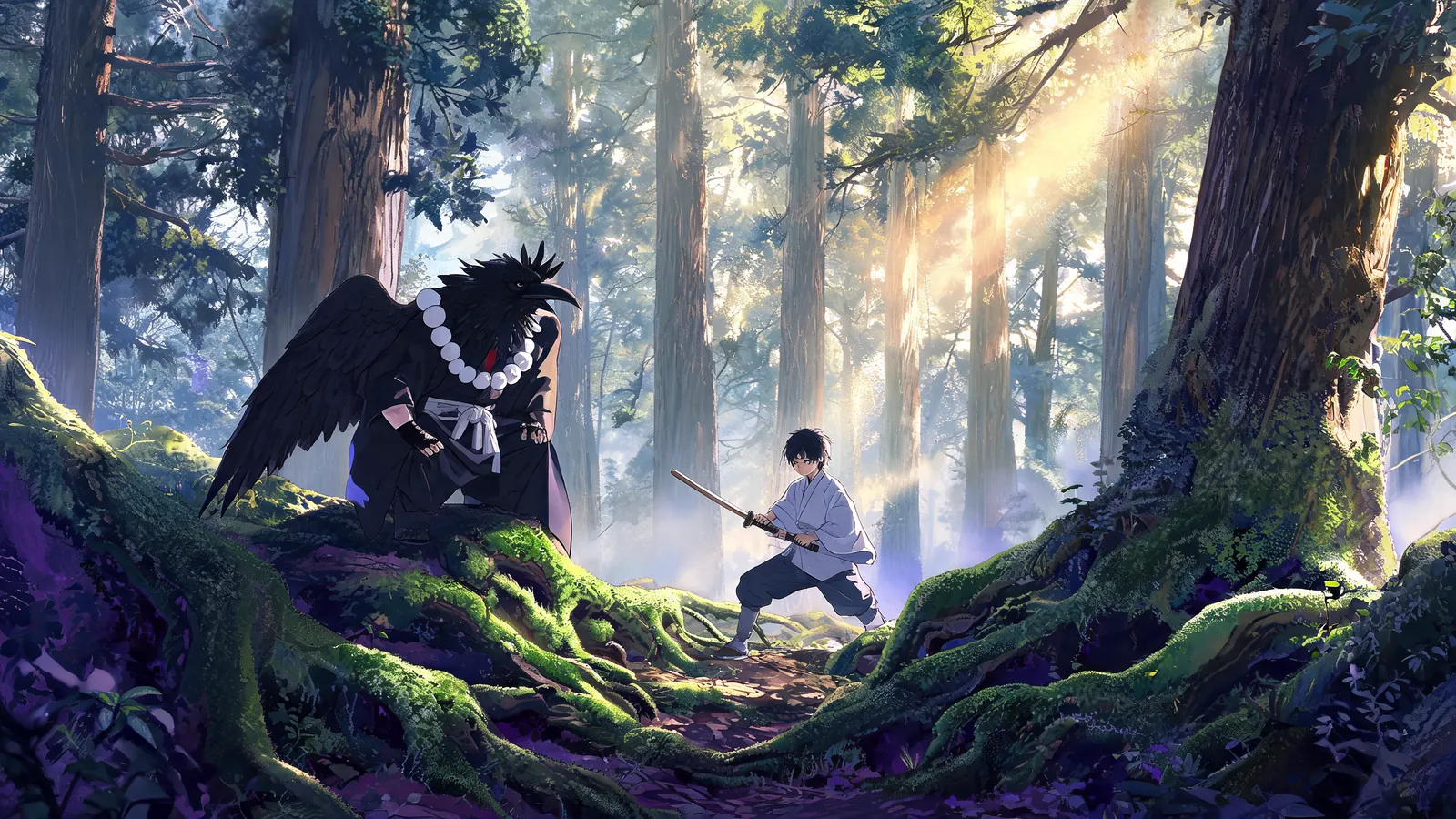
You'll meet two main forms. The older one is the crow tengu, karasu tengu (烏天狗), with a beak, feathers and wings, much closer to a bird. The younger one is the great tengu, daitengu (大天狗), with a red human face, a very long nose and often a fan made of feathers. The long-nosed form became common from the late Middle Ages and is the one on almost every mask today. In many depictions a great tengu leads a group of crow tengu, a bit like a mountain abbot with his monks.
Look at the clothes, and you'll notice something. Both kinds usually dress like a yamabushi, a mountain ascetic of Shugendō: the small black cap on the forehead, the sash with large pom-poms, the ringed staff, sometimes a conch shell. That isn't an accident. Tengu and yamabushi live in the same mountains, they're said to have powers beyond the ordinary, and over time the two images simply merged. In a way, the tengu became the mountain's own yamabushi.
Sōjōbō and the boy on Kurama
The most famous tengu of all lives on Kurama, the mountain range north of Kyoto. His name is Sōjōbō (僧正坊). The legend goes back to the twelfth century, to the wars between the two great warrior clans Taira and Minamoto. After the Taira had killed the leading men of the Minamoto, they spared the women and children. One of the boys, Ushiwakamaru, later known as Minamoto no Yoshitsune, was sent to the temple Kurama-dera to become a monk, far from politics, without being told who he was.
He had little interest in becoming a monk. Day after day he slipped out of the temple into the forest, and there, so the story goes, Sōjōbō and his tengu trained him in the sword. Years later the young Yoshitsune met the feared warrior monk Benkei on a bridge in Kyoto. Benkei had sworn to take a hundred swords and let nobody across who didn't fight him. Yoshitsune didn't attack. He danced back and forth the way he'd learned among the roots until the giant Benkei collapsed from exhaustion and gave up. From then on Benkei followed him for the rest of his life.
The legend took shape over the following centuries, in war tales, Noh plays and later in kabuki, so we shouldn't take it as history. But you can still see the place in the Kurama forest where Yoshitsune is said to have trained. The roots of the old cedars run over the ground so thickly that you trip if you don't watch your feet. As a place to practice footwork for martial arts, it's ideal. There's a small shrine for Yoshitsune nearby.
Kurama is also the mountain where Mikao Usui, the founder of Reiki, meditated before he began to pass on Reiki. If that side of the story interests you, have a look at Shingon Reiki Level 1, my live event in English.
Where you can meet tengu today
- Kurama, north of Kyoto. The temple Kurama-dera, the forest path with the roots, the Yoshitsune shrine and a big tengu at the train station. Watch out for the Japanese black bears and the mamushi snakes, by the way. The warning signs on the path are real.
- Mount Takao, west of Tokyo. At the temple Yakuō-in, statues of a great tengu and a crow tengu stand guard, and the mountain is an easy day trip.
- Shrine festivals. In many parts of Japan a figure with a long-nosed tengu mask leads the procession, often identified with Sarutahiko, the kami who guides the way.
- The yamabushi themselves. On mountains such as Dewa Sanzan or Ōmine, where Shugendō is practiced, you can see the clothes the tengu borrowed.
For me the tengu stand for an idea that runs through Japanese mountain practice: the mountain itself is the master, and the spirits who live there pass on what it has to give. If a tengu offered to train you on his mountain, what would you ask him for?
The Japanese Grimoire Society
Mountains, yamabushi and the spirits who live up there are one of the big themes of the Japanese Grimoire Society. We look at the sources and at the practice that grew out of them. You can start with a free trial.
Have a look insideQuick answers
What is a tengu?
A tengu (天狗) is a mountain spirit of Japanese folklore. Early tengu were dangerous beings who misled monks; later many came to be seen as protectors of sacred mountains. They appear in two main forms, the bird-like crow tengu and the red-faced, long-nosed great tengu.
Why does the tengu have a long nose?
The earliest tengu were bird-like, with a beak. The long-nosed, red-faced form became common from the late Middle Ages onward and is the one you see on most masks today. In Japanese, 'becoming a tengu' (tengu ni naru) means getting conceited, and the long nose became a sign of pride.
Who is Sōjōbō?
Sōjōbō is the great tengu of Mount Kurama north of Kyoto. According to legend he trained the young Minamoto no Yoshitsune in swordsmanship in the forests around Kurama-dera.
Why do tengu dress like yamabushi?
Tengu live in the mountains, and so do the yamabushi, the mountain ascetics of Shugendō. Over the centuries the two images merged, and the tengu came to wear the ascetic's small cap, the sash with pom-poms and the staff.
Sources and further reading
- Nihon Shoki (720), entry for the ninth year of Emperor Jomei (637) on the 'heavenly dog'.
- Sarashina Nikki, early 11th century, on the fearsome reputation of Kurama.
- Mark Hosak, chapter on the Kurama mountains in The Big Book of Reiki Symbols: The Spiritual Transition of Symbols and Mantras of the Usui System of Natural Healing (Lotus Press).
- Haruko Wakabayashi, The Seven Tengu Scrolls: Evil and the Rhetoric of Legitimacy in Medieval Japanese Buddhism, University of Hawai'i Press, 2012.
Dr. Mark Hosak
Japanologist with a PhD from Heidelberg University and about three years of research at Kyoto University on Buddhist art, architecture and ritual. Shingon practitioner and researcher, successor of Taguchi Sensei in his line of Ninjutsu, author of books on Reiki and its Japanese roots. He walked all 88 temples of the Shikoku pilgrimage on foot.