Demon Slayer's Real Japan: Hinokami Kagura, Hanafuda Earrings and Oni Lore
You've seen Tanjiro dance with fire, wear his father's earrings and hunt demons with a blade that drinks the sun. Behind each of these is a piece of real Japan, and one of them is a National Treasure.
Demon Slayer is set in the Taishō period, the short era between 1912 and 1926, when Japan had trains and electric light in the cities and almost nothing had changed in the mountain villages. That mix is part of its charm, and the author put a surprising amount of real Japanese tradition into it. Let's go through the most visible pieces.
Kamado: a family named after the hearth
It starts with the family name. Kamado (竈門) contains the character for the kitchen hearth, the clay stove that was the center of every old Japanese house. And the hearth had its own kami. In many regions people honored a hearth or fire kami in the kitchen, often called Kōjin or Kamado-gami, with a small talisman or a shelf above the stove. Fire was what kept a family alive, and it was also what could burn the house down, so it was treated with respect.
Put simply, a family named after the hearth that dances for the fire god every New Year is a very Japanese idea. And there's a real Kamado Shrine, Kamado Jinja, on Mount Hōman near Dazaifu in Fukuoka. It was famous long before the anime as a shrine for good relationships and as a place of mountain practice. Since the series came out, it has also become a pilgrimage spot for fans, which the shrine has taken with good humor.
Hinokami Kagura and real kagura
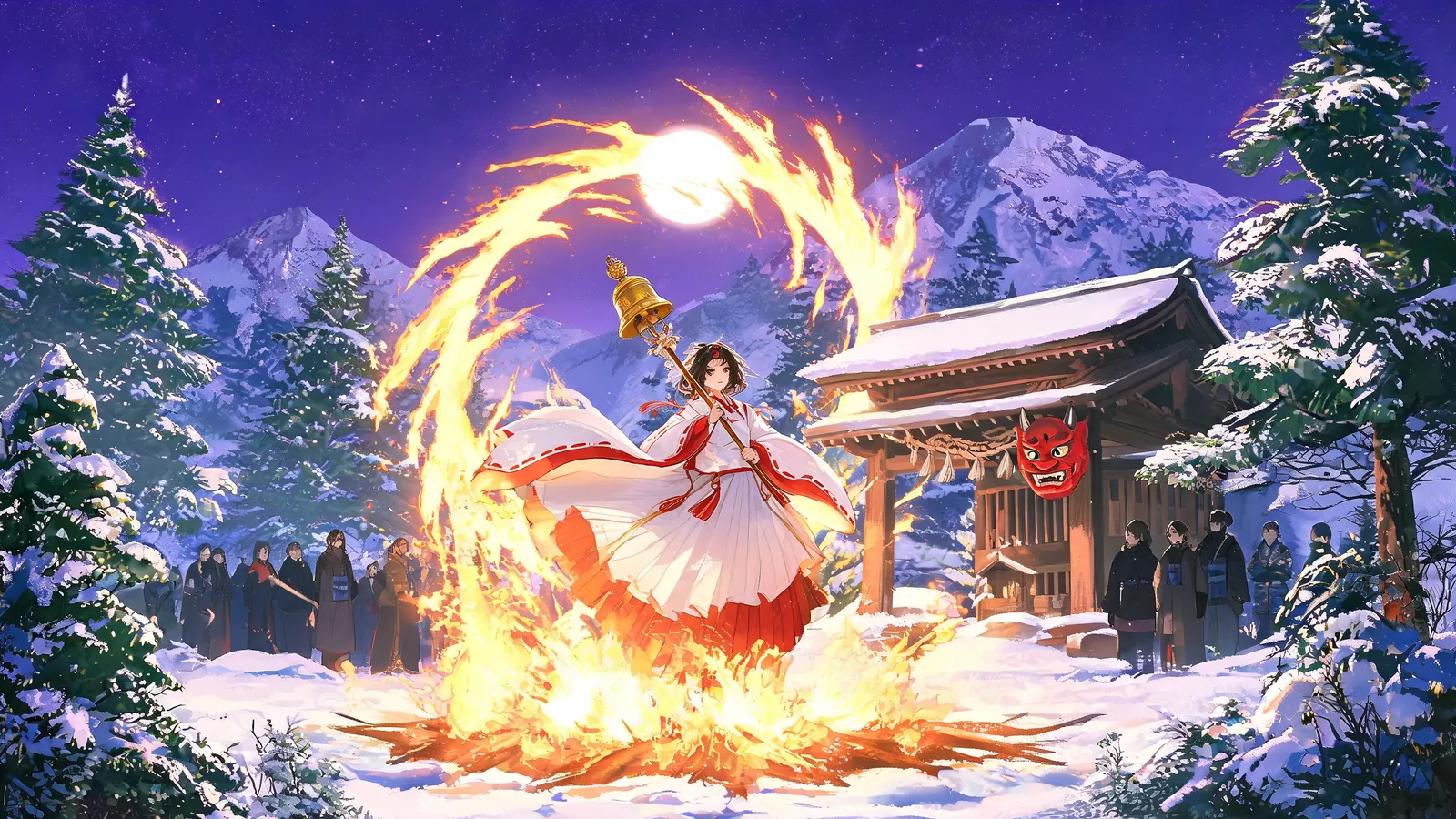
In the story, Tanjiro's father dances the Hinokami Kagura, the kagura of the fire god, all night long on New Year's Eve, in the snow, without tiring, to ask for protection for the coming year. The dance itself is fictional. The tradition behind it is not.
Kagura (神楽) is written with the characters for kami and music or pleasure. It means sacred music and dance performed to please the kami and to call down their power. Its mythical origin is the moment when the sun kami Amaterasu hid in a rock cave and the world went dark. The goddess of dance, Ame-no-Uzume, danced so wildly in front of the cave that the other kami burst out laughing, Amaterasu peeked out to see what was going on, and light returned to the world.
Japan has many kagura traditions. At the imperial court and at great shrines there are slow, solemn forms. In the villages, sato kagura developed into something much more dramatic. In Takachiho in Miyazaki, villagers still perform the yokagura, thirty-three dances through a whole winter night, in private homes, from November into February. The Iwami kagura of Shimane is full of fierce demons, fire, fast drumming and a giant eight-headed serpent. So an all-night winter dance for the kami, performed by a family to protect their village, isn't far from reality at all.
The breath
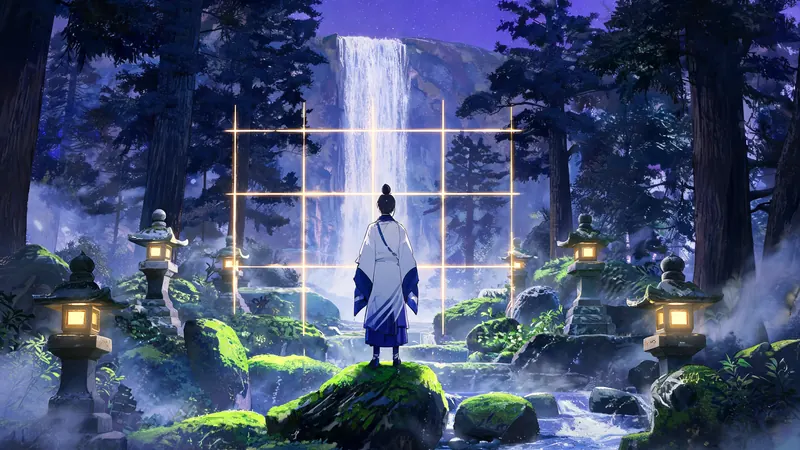
The whole fighting system of Demon Slayer is built on breathing techniques. That's fiction too, of course, at least the part where you split waterfalls with it. But the idea that breath is the root of strength runs through Japanese martial arts and through the meditations of esoteric Buddhism, where some of the most basic practices begin with nothing more than counting the breath. I won't go into how those are done here, because that part is passed on in person.
The hanafuda earrings
Tanjiro's earrings look like a pair of small playing cards with a rising sun. Fans immediately recognized the style of hanafuda (花札), the Japanese flower cards. A hanafuda deck has forty-eight cards in twelve suits, one for each month, each with its flower or plant: pine for January, plum for February, cherry for March and so on. The cards were played across Japan for centuries, and a small company in Kyoto that started making them in 1889 later became world-famous for video games. You probably know its name.
In the story the earrings are an heirloom that carries the memory of the first swordsman of sun breathing. In real Japanese culture, hanafuda belong to the world of games, gambling and the seasons. The connection the author draws is his own, and it's a beautiful one.
Oni: where the horns come from
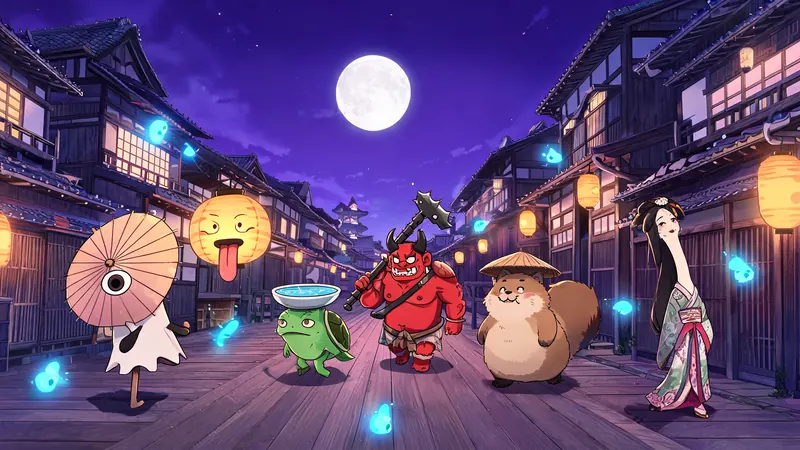
The demons of Demon Slayer are called oni (鬼), and the classic Japanese oni has a very recognizable look: horns, wild hair, a tiger-skin loincloth and an iron club. A common explanation for this look comes from the old system of directions. The northeast was considered the kimon, the demon gate, the direction from which bad influences entered. In the zodiac of directions the northeast lies between the ox and the tiger, ushitora (丑寅). So the demon got the horns of an ox and the skin of a tiger. That's the kind of logic Japan loves.
Every year in early February, at Setsubun, people all over Japan throw roasted soybeans out of the door and shout "Oni wa soto, fuku wa uchi," demons out, good fortune in. At some shrines the old court rite of driving out demons is still performed, with a four-eyed exorcist chasing the oni through the grounds.
The real demon slayer
The most famous demon story of Japan is that of Shuten-dōji, the demon king of Mount Ōe, who kidnapped young women from Kyoto. The warrior Minamoto no Raikō and his four retainers disguised themselves as mountain ascetics, got the demon drunk on magic sake and cut off his head. One of the four retainers, by the way, was Sakata no Kintoki, who as a boy was the strong child Kintarō.
Here comes the remarkable part. The sword Raikō is said to have used is real. It's called Dōjigiri, the "demon-cutter," it was forged by the smith Yasutsuna, and it's a National Treasure in the Tokyo National Museum.
In the Shingon tradition, though, the being I'd call the real demon slayer is Fudō Myōō, the Immovable Wisdom King, a great protector in Shingon and Tendai who looks grim but is deeply kind, with a sword in his right hand and flames all around him. His sword cuts through what binds you, and his rope pulls you back to safety. If you've read the article on Kuji Kiri, you've met him already.
Fudō Myōō stands close to the nine seals of Kuji Kiri. Dates for the Kuji Kiri live events are on the Kuji Kiri page of shingon-reiki.com, and to start at home there's the Kuji Kiri Level 1 Online Course.
And the tengu mask
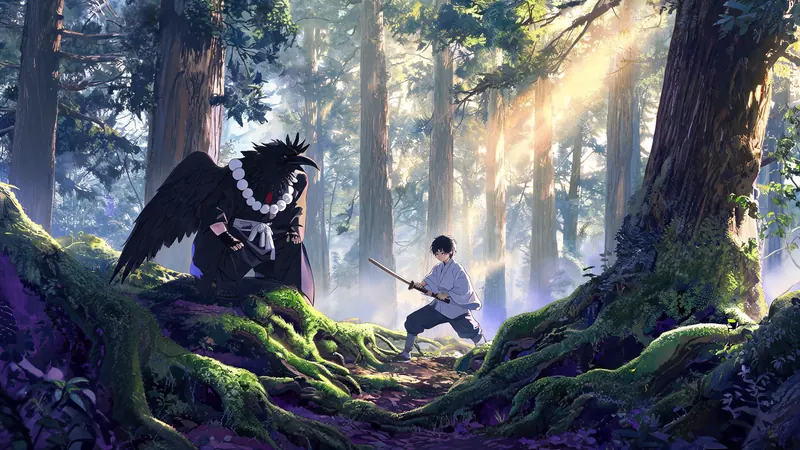
Tanjiro's master, Urokodaki, lives on a mountain and wears a red tengu mask. That's a clear nod to the tengu, the mountain spirits who, according to legend, trained the young Minamoto no Yoshitsune on Mount Kurama. I tell that story in the article on tengu.
The wisteria that keeps the demons away in the series, on the other hand, I don't know from any older Japanese tradition. As far as I can tell, that one is the author's own idea.
Where you can see it today
- Takachiho, Miyazaki. The all-night yokagura in winter, plus a shorter evening performance for visitors at Takachiho Shrine throughout the year.
- Iwami kagura, Shimane. Regular performances with demons, fire and serpents.
- Kamado Jinja, Dazaifu. The shrine of the hearth name, on a mountain of old ascetic practice.
- Tokyo National Museum. The sword Dōjigiri, when it's on display.
- Setsubun, early February. At almost any shrine or temple, with beans and oni masks.
Which breathing style would you have chosen for yourself?
The Energy Between Your Hands
Breath, hands and the old Japanese ways of protection are at the heart of what I write about. If you'd like a taste, leave your email and you'll get a short practice from the Japanese tradition as a free PDF, plus a few letters from me about the real tradition behind the anime.
Free. Unsubscribe anytime. Privacy policy
Quick answers
Is Hinokami Kagura real?
The specific dance in Demon Slayer is fictional, but kagura (神楽), sacred music and dance performed for the kami, is very real. Village kagura traditions such as Takachiho's all-night yokagura or the dramatic Iwami kagura are still performed today.
What do Tanjiro's earrings mean?
Their design resembles hanafuda, the Japanese flower cards with twelve suits for the twelve months. In the story the earrings carry the memory of the original sun-breathing swordsman.
Why do oni have horns and tiger-skin loincloths?
A common explanation links the oni to the northeast, the 'demon gate.' In the old zodiac system the northeast is ushitora, ox and tiger, so the demon was given the horns of an ox and the skin of a tiger.
Is there a real demon-slaying sword?
According to legend, the warrior Minamoto no Raikō beheaded the demon king Shuten-dōji with a sword later called Dōjigiri, the 'demon-cutter.' The sword is real, it was made by the smith Yasutsuna, and it is a National Treasure kept at the Tokyo National Museum.
Sources and further reading
- Tokyo National Museum, Tachi, known as Dōjigiri Yasutsuna, National Treasure (collection information).
- Takachiho Town and Takachiho Shrine, information on the Takachiho yokagura (Important Intangible Folk Cultural Property).
- Noriko T. Reider, Japanese Demon Lore: Oni from Ancient Times to the Present, Utah State University Press, 2010.

Dr. Mark Hosak
Japanologist with a PhD from Heidelberg University and about three years of research at Kyoto University on Buddhist art, architecture and ritual. Shingon practitioner and researcher, successor of Taguchi Sensei in his line of Ninjutsu, author of books on Reiki and its Japanese roots. He walked all 88 temples of the Shikoku pilgrimage on foot.