Oni: Japan's Demons from Folklore to Setsubun
You've seen them as the horned villains of Demon Slayer, as Momotarō's enemies and as the scary mask at Setsubun. Japan's oni have a long and surprisingly complicated career, and in a few places people still invite them in.
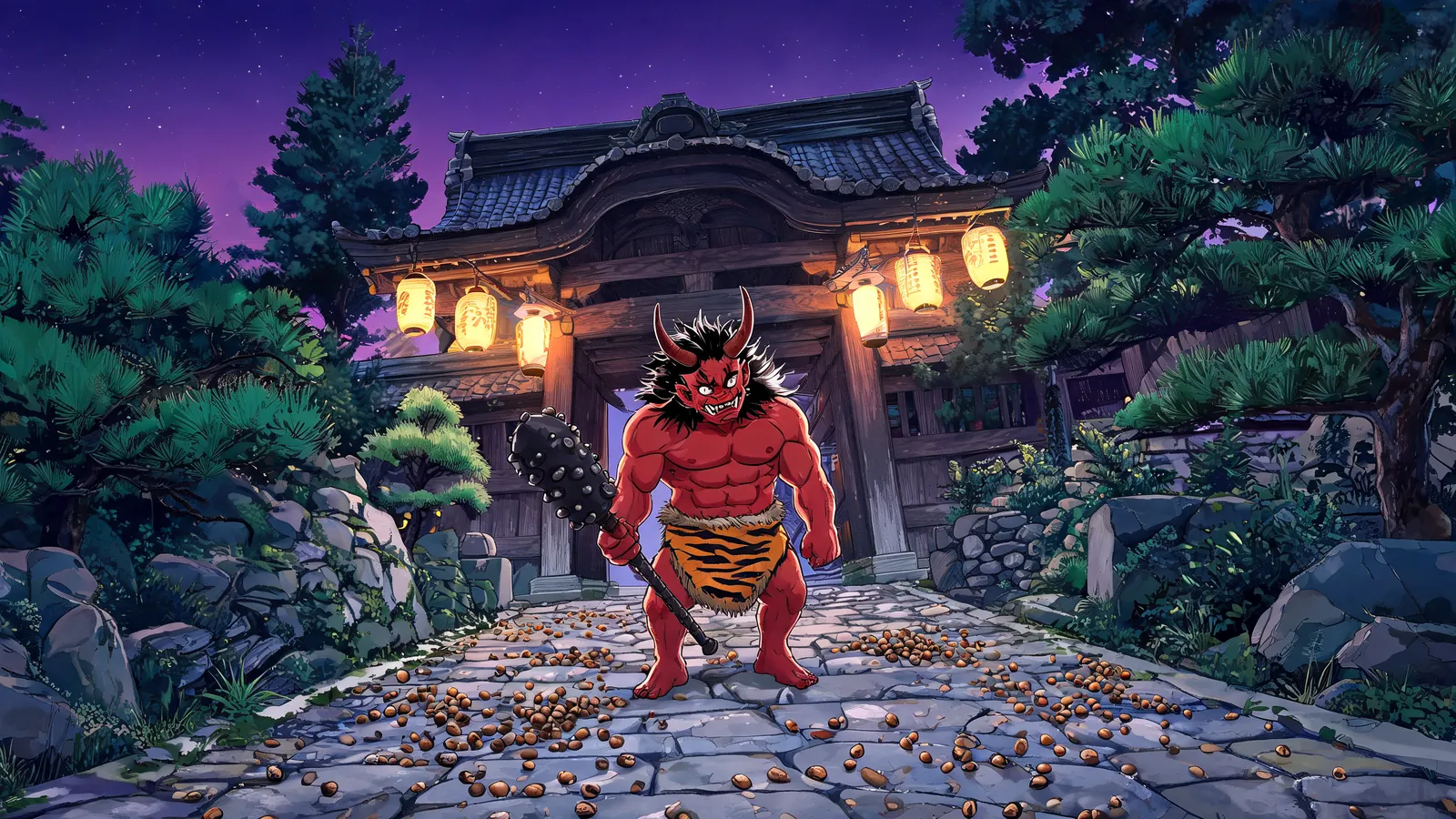
Every February, millions of Japanese people throw roasted soybeans out of their front doors and shout at demons. Children love it, because one parent usually has to wear the oni mask and get pelted. It's one of the most cheerful festivals of the year. The figure behind that mask, though, has been frightening people for well over a thousand years, and its history is much stranger than the red face suggests.
The hidden ones
The character for oni, 鬼, comes from China, where it means the spirit of a dead person, a ghost. In Japan it went another way. A dictionary of the tenth century, the Wamyō Ruijushō, explains the native reading oni as coming from on (隠), hidden, because these beings hide and don't want to be seen. In other words, the earliest oni were invisible powers: disease, disaster, the uncanny thing that comes at night.
Only over the following centuries did they get a body. Buddhist hell paintings contributed the wardens of hell, some with ox heads and some with horse heads. Picture scrolls added muscular demons with horns and clubs. And the direction system of the court diviners added the final touch. The northeast was considered the demon gate, kimon, and in the zodiac of directions it lies between ox and tiger, ushitora. So the oni got ox horns and a tiger-skin loincloth. I've written more about that logic in the article on Demon Slayer.
That's why Japanese temples and houses often have a protective feature at the northeast corner, and why you'll find fierce oni faces on the end tiles of old roofs, the onigawara. A demon face to keep demons away is a very old trick.
The famous demons
Shuten-dōji
The demon king of Mount Ōe, who kidnapped young women from Kyoto, was defeated by the warrior Minamoto no Raikō and his four retainers. They came disguised as mountain ascetics, got him drunk on magic sake and cut off his head. Raikō's sword, Dōjigiri, is a National Treasure today.
Ibaraki-dōji
Shuten-dōji's companion is said to have attacked Watanabe no Tsuna, one of Raikō's retainers, in Kyoto. Tsuna cut off the demon's arm. Later the oni came back disguised as Tsuna's aunt, asked to see the arm one last time, grabbed it and flew off through the roof. It's one of the classic plots of kabuki, and the lesson is clear: never show a demon its own arm.
The oni of Momotarō
Every Japanese child knows Momotarō, the boy born from a peach who sails to the demons' island with a dog, a monkey and a pheasant. In Okayama the story has an older relative. At Kibitsu Shrine, the legend tells of Ura, a powerful being from overseas who lived in a mountain fortress and was defeated by the prince Kibitsuhiko. Ura's head is said to lie buried beneath the shrine's kitchen, under a great iron cauldron, and to this day the shrine performs a rite in which the roar of that cauldron is read as an oracle. Many in Okayama see this as the root of the Momotarō tale.
Oni that changed sides
Here's something most people outside Japan don't know. Not all oni stayed villains. In the mountain practice of Shugendō, the legendary founder En no Gyōja is said to have tamed a married pair of oni, Zenki and Gōki, who then served him as attendants. You'll see them in statues next to him, one with an axe and one with a water jar. A hamlet in the Ōmine mountains still bears Zenki's name.
At Kinpusen-ji in Yoshino, one of the main temples of Shugendō, the Setsubun call is different from everywhere else: Fuku wa uchi, oni mo uchi, "good fortune in, and the demons in, too." The oni are invited in so they can be converted. I find that very fitting for a mountain tradition that likes to transform the wild instead of destroying it. More on the mountain ascetics in the article on Shugendō.
In the north, on the Oga Peninsula in Akita, the Namahage visit homes on New Year's Eve in demon masks and straw capes, asking loudly whether there are lazy children in the house. They're not demons in the strict sense. They're visitors from beyond who bring blessings along with the scare, and the custom is listed by UNESCO as part of Japan's intangible cultural heritage.
Women who became demons
The Noh theater has its own oni. The Hannya mask shows a woman transformed into a demon by jealousy and grief, with horns, gold-rimmed eyes and a mouth stretched wide. What makes it such a strong mask is that, depending on the angle, it looks furious or deeply sad. Japanese tradition knew very well that demons often start as human pain.
Oni in Japanese today
The oni has settled firmly into everyday language. Oni ni kanabō (鬼に金棒), "giving an iron club to an oni," means making the strong even stronger. When children play tag, the one who chases is called the oni. And oni as a prefix simply means extremely, so oni muzui is youth slang for "brutally hard."
Where you can meet oni today
- Setsubun, around February 3. Bean-throwing at shrines and temples everywhere, often with famous guests throwing beans from a stage.
- Kinpusen-ji, Yoshino. The Setsubun where the demons are welcome.
- Kibitsu Shrine, Okayama. The cauldron of Ura and the long covered corridor of the shrine.
- Mount Ōe, Kyoto Prefecture. The home of Shuten-dōji, with a small museum about oni at the foot of the mountain.
- Oga Peninsula, Akita. The Namahage museum, for when you can't be there on New Year's Eve.
If you had to play the oni at Setsubun, would you rather run or throw beans back?
The Energy Between Your Hands
There's a lot more to Japan's spirits than this site can hold. If you'd like to hear about new articles, leave your email. You'll also get a short practice from the Japanese tradition as a free PDF.
Free. Unsubscribe anytime. Privacy policy
Quick answers
What is an oni?
An oni (鬼) is a demon or ogre of Japanese folklore, usually shown with horns, wild hair, red or blue skin, a tiger-skin loincloth and an iron club. In early Japan the word referred to invisible, frightening powers; the horned image developed later.
Why do people throw beans at oni?
At Setsubun, the day before the traditional start of spring in early February, people throw roasted soybeans and shout 'Oni wa soto, fuku wa uchi,' 'demons out, good fortune in,' to drive away misfortune before the new season begins.
Are all oni evil?
No. Some oni were converted and became protectors, such as Zenki and Gōki, the two oni who served the Shugendō founder En no Gyōja. At Kinpusen-ji in Yoshino, people even call out 'demons in, too' at Setsubun.
What is a Hannya mask?
A Hannya mask is a Noh theater mask showing a woman who has turned into a demon out of jealousy and grief, with horns, golden eyes and a wide mouth.
Sources and further reading
- Noriko T. Reider, Japanese Demon Lore: Oni from Ancient Times to the Present, Utah State University Press, 2010.
- Minamoto no Shitagō, Wamyō Ruijushō (c. 930s), entry on the reading of 鬼.
- Kibitsu Jinja (Okayama), Kinpusen-ji (Yoshino) and the Namahage Museum (Oga), official information.

Dr. Mark Hosak
Japanologist with a PhD from Heidelberg University and about three years of research at Kyoto University on Buddhist art, architecture and ritual. Shingon practitioner and researcher, successor of Taguchi Sensei in his line of Ninjutsu, author of books on Reiki and its Japanese roots. He walked all 88 temples of the Shikoku pilgrimage on foot.