Shugendō and the Yamabushi: Japan's Mountain Mystics
You've seen their caps and pom-pom sashes on tengu in every yokai anime. The yamabushi are real, they still blow conch shells on mountain ridges, and they carried the nine seals into Japanese village life.

If you've ever seen a tengu in an anime, you've already seen a yamabushi's clothes: the tiny black cap on the forehead, the sash with big round pom-poms, the ringed staff. The mountain spirits borrowed their wardrobe from real people. Those people still exist, and their tradition is one of the oldest and most interesting in Japan.
The way of power through practice
Shugendō (修験道) is usually translated as "the way of acquiring power through ascetic practice." The practitioners are called yamabushi (山伏), "those who lie down in the mountains," or shugenja. Put simply, they go into the mountains to train body and spirit, and they come back with abilities that are useful to others: protection, purification, blessing, divination.
The tradition is a meeting place. It brings together the ancient Japanese worship of mountains as the home of kami and ancestors, Shintō, the esoteric Buddhism of Shingon and Tendai, and Daoist and yin-yang ideas from China. Here I'd like to explain a cultural principle that helps with this. In Japan the old is rarely thrown away when something new arrives. It lives on next to it and slowly blends in. Shugendō is perhaps the best example of all.
En no Gyōja, the founder
Tradition names En no Gyōja, also called En no Ozunu, as the founder. He's a semi-legendary figure, but he does appear in the historical record. The court chronicle Shoku Nihongi notes that in 699 he was banished to the Izu Peninsula after being accused of misleading people with sorcery, and it adds that people said he commanded spirits to draw his water and gather his firewood.
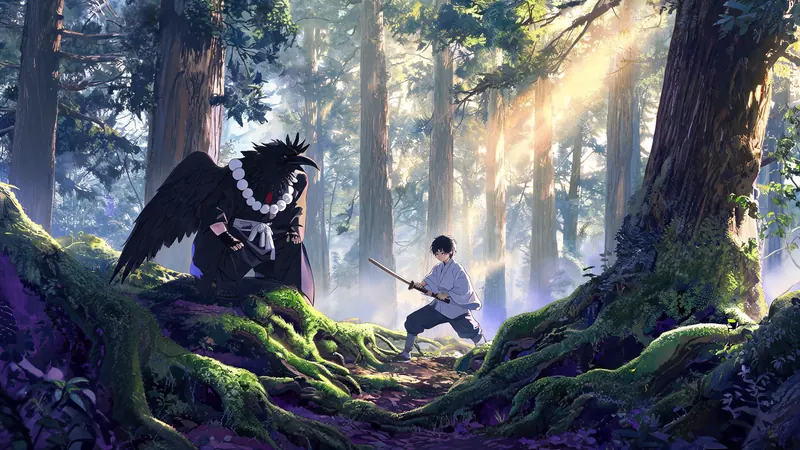
Later legend made much more of him. He's said to have flown across the sea at night, to have climbed Mount Fuji, and to have called up the fierce protector Zaō Gongen on Mount Kinpu in the Yoshino mountains, a being who combines the power of buddhas and of the mountain itself. And he tamed two oni, Zenki and Gōki, who became his servants, which I mention in the article on oni. Statues of En no Gyōja show a bearded old man in high sandals, with the two oni at his side.
The mountain as a mandala
Here comes the part I find most fascinating. In Shugendō a mountain isn't just a place to climb. It's a living mandala, a map of the universe that you walk through with your feet.
The great trail through the Ōmine range, from Yoshino in the north to Kumano in the south, was understood as a passage between the two great mandalas of esoteric Buddhism, the Diamond Realm and the Womb Realm. On the three mountains of Dewa Sanzan in Yamagata, the mountains stand for past, present and future. Walking them in sequence is understood as dying and being reborn.
Clothes and tools
A yamabushi's outfit isn't a costume. Each piece has a meaning. A few of the most visible ones:
- Tokin (頭襟), the small black cap worn on the forehead.
- Yuigesa (結袈裟), the sash with six large pom-poms, a compact form of the Buddhist monk's stole.
- Shakujō (錫杖), the ringed staff whose rings rattle as you walk, traditionally to warn animals and to drive off harmful influences.
- Horagai (法螺貝), the conch-shell trumpet. Its deep sound carries across valleys, and it's used to signal and to purify.
- Oi (笈), a wooden backpack-like box for sacred objects and texts.
Practice in the mountains
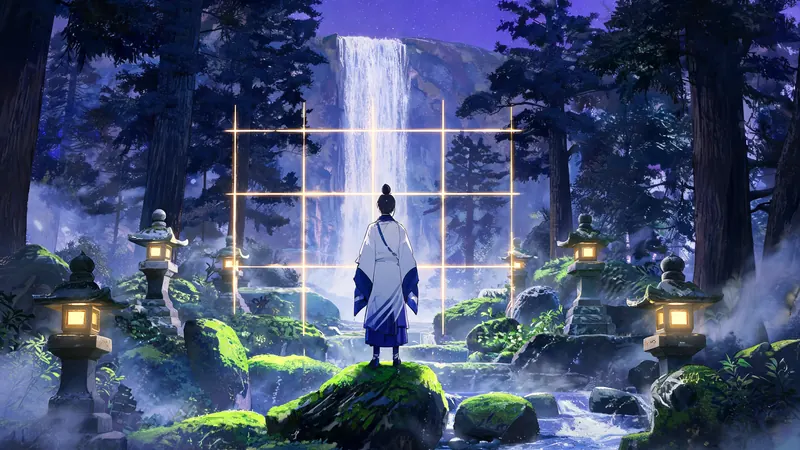
The practices are demanding. Long mountain walks, sometimes over many days, chanting at sacred spots, standing under waterfalls, fasting, fire rituals with wooden sticks on which prayers are written. On Ōmine's main peak, Sanjōgatake, practitioners are held head-first over a cliff by a rope and asked whether they'll be good to their parents. That's one of the more memorable moments of the tradition.
During my research in Kyoto I had the chance to take part in esoteric rituals and to do ascetic practice with mountain ascetics and high-ranking monks in the forests. I'm not going to describe how those practices are done. They belong to the people who pass them on, and they're done under guidance for good reasons.
Shugendō was also the great carrier of everyday magic in old Japan. Yamabushi traveled from village to village, performed purifications, made talismans and used the nine characters of Kuji Kiri for protection. A lot of what later became famous as "ninja magic" passed through their hands first.
The Kuji Kiri ritual itself, with Fudō Myōō, the fierce but deeply kind Immovable Wisdom King and great protector, and the nine characters, is the subject of Kuji Kiri Level 2 within the Kuji Kiri Master Path. Dates are on the Kuji Kiri page of shingon-reiki.com, and to start at home there's the Kuji Kiri Level 1 Online Course.
Banned, and back
In 1872 the Meiji government, which was separating Shintō and Buddhism, banned Shugendō outright. Yamabushi had to become either Shintō priests or Buddhist monks. Many traditions were lost. After 1945 religious freedom allowed Shugendō to return, and today it's practiced by temple-affiliated groups and by lay practitioners, and some programs on Dewa Sanzan and elsewhere are open to visitors.
Where you can meet yamabushi today
- Dewa Sanzan, Yamagata. Mount Haguro with its 2,446 stone steps and its five-storied pagoda in the cedar forest, the center of a lively Shugendō tradition.
- Yoshino and Kinpusen-ji, Nara. The huge blue figures of Zaō Gongen, shown on special occasions, and the gateway to the Ōmine range.
- Kumano, Wakayama. The southern end of the Ōmine trail and one of the great sacred regions of Japan.
- Fire rituals. Many Shugendō groups hold public outdoor fire ceremonies, often in spring, where the sound of the conch shells is unforgettable.
Would you rather stand under a waterfall or hang over a cliff for your parents' sake?
The Japanese Grimoire Society
The mountain practice and the nine seals that came out of it are at the heart of the Japanese Grimoire Society. We look at the sources and at the practice. You can start with a free trial.
Have a look insideQuick answers
What is Shugendō?
Shugendō (修験道) is a Japanese tradition of mountain asceticism that combines ancient mountain worship and Shintō with esoteric Buddhism, Daoist and yin-yang elements. Its practitioners, the yamabushi, seek spiritual power through practice in sacred mountains.
Who founded Shugendō?
Tradition names En no Gyōja (also En no Ozunu), a mountain ascetic of the late seventh century. The court chronicle Shoku Nihongi records that he was banished to Izu in 699 and that people said he commanded spirits.
Does Shugendō still exist?
Yes. It was banned by the Meiji government in 1872 and revived after 1945. Today it is practiced on mountains such as Ōmine and Dewa Sanzan, by temple-affiliated groups and by lay practitioners, and some programs are open to visitors.
What does a yamabushi wear?
Typically a small black cap on the forehead (tokin), a robe called suzukake, a sash with large pom-poms (yuigesa), a ringed staff (shakujō) and a conch-shell trumpet (horagai), among other items.
Sources and further reading
- Shoku Nihongi (797), entry for 699 on En no Ozunu.
- H. Byron Earhart, A Religious Study of the Mount Haguro Sect of Shugendō, Sophia University, 1970; Miyake Hitoshi, Shugendō: Essays on the Structure of Japanese Folk Religion, University of Michigan, 2001.
- Mark Hosak, chapters on Shugendō and Kuji kiri in The Big Book of Reiki Symbols: The Spiritual Transition of Symbols and Mantras of the Usui System of Natural Healing (Lotus Press).
Dr. Mark Hosak
Japanologist with a PhD from Heidelberg University and about three years of research at Kyoto University on Buddhist art, architecture and ritual. Shingon practitioner and researcher, successor of Taguchi Sensei in his line of Ninjutsu, author of books on Reiki and its Japanese roots. He walked all 88 temples of the Shikoku pilgrimage on foot.