Misogi: The Real Shinto Purification Behind the "Misogi Challenge"
You've seen "misogi" on self-improvement podcasts, as the name for one brutal challenge a year. In Japan the word is much older. It goes back to a kami washing off the land of the dead.
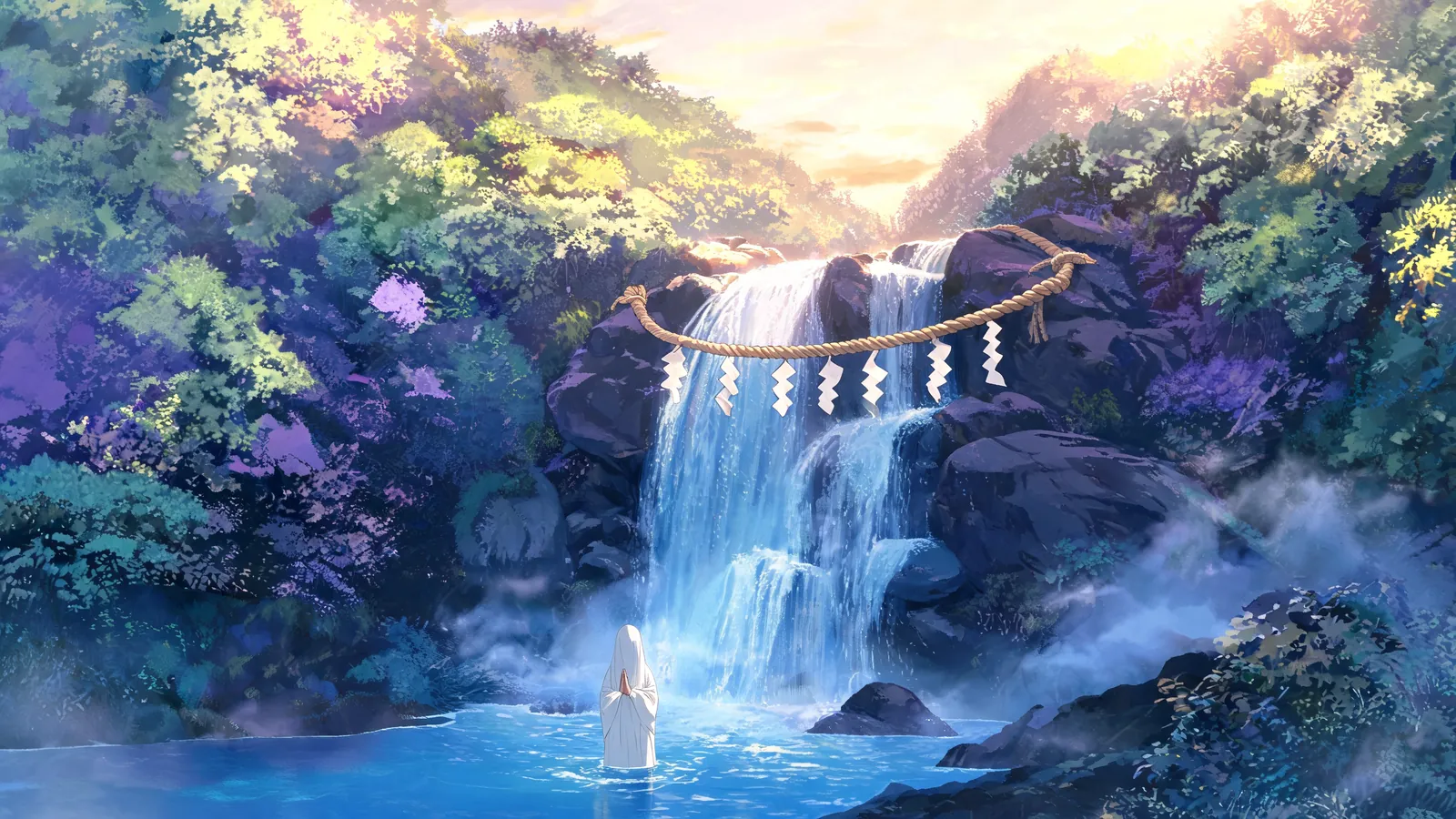
If you listen to self-improvement podcasts, you may have heard of the "misogi challenge": once a year you do something so hard that you have a real chance of failing, like paddling a long distance or carrying a heavy stone underwater, and you come back changed. It's a good idea, and it borrowed a good word. In Japan, though, misogi means something older, quieter and colder.
A kami who washed off death
The story is in the Kojiki, Japan's oldest chronicle, completed in 712. The creator kami Izanagi has followed his dead wife into the land of the dead, seen her decaying body and fled. Back in the world of the living, he feels the pollution of death clinging to him. So he goes to a river mouth in Hyūga, in southern Kyushu, takes off his clothes and his ornaments, and washes himself in the water.
As he does, kami are born from everything he takes off and from every part of his body he washes. At the very end, from his left eye, his right eye and his nose, come the three greatest: Amaterasu, the sun, Tsukuyomi, the moon, and Susanoo, the storm. I tell their story in the article on Amaterasu and Susanoo. So the most important kami of Japan were born from an act of purification. That tells you how central the idea is.
Kegare is not sin
To understand misogi, you need one more word: kegare (穢れ), impurity or pollution. In Shintō, contact with death, blood, illness or disorder makes a person impure. Here's the important difference from many Western ideas. Kegare is not guilt. You haven't done anything wrong when you attend a funeral. You've simply been touched by something that weighs on your life force, a bit like dust settling on a mirror. Purification wipes the dust away, and the original brightness is there again.
Shintō has a lovely old phrase for the state it aims at, a bright and pure heart. In plain terms, misogi means returning to the clear state you started from, and punishment has nothing to do with it.
Misogi and harae
Purification in Shintō is called harae (祓) in general. You see it when a priest waves a wand with white paper streamers over people or objects, or at the great purifications held twice a year at shrines all over Japan, at the end of June and on New Year's Eve. In June many shrines set up a large ring of woven grass that visitors walk through, and people transfer their impurities onto small paper figures that are then floated away or burned.
Misogi (禊) is the form of purification that uses water. In other words, every misogi is a harae, but not every harae is a misogi.
Where the water comes in
You've almost certainly done a miniature misogi if you've ever visited a shrine. At the entrance there's a water basin with wooden ladles, the temizuya. Rinsing your hands and mouth there before you approach the kami is the everyday form of the same idea.
The full forms are much more demanding. People stand in rivers or in the sea, or under waterfalls, often in winter and often at dawn. Pilgrims to Ise traditionally purified themselves in the sea at Futami before visiting the Grand Shrine, near the famous "wedded rocks" joined by a sacred rope. In the mountain practice of Shugendō, standing under a waterfall is called takigyō, waterfall practice, and it's one of the core ascetic practices of the yamabushi. More on them in the article on Shugendō.
I have my own experience with cold water from the Shikoku pilgrimage. Walking in the summer heat, I often climbed into mountain streams so cold that you can normally only stand them for a few seconds, and with the mantra of Fudō Myōō, the Immovable Wisdom King and great protector who frees people from negative influences, which I had received from my master, I could stay in them for a long time. That's my experience and nothing more.
What the challenge borrowed, and what it left behind
The modern "misogi challenge" borrowed two real things: the difficulty, and the idea that you come out of it renewed. That's fair, and it isn't my job to tell anyone how to use a word. What it leaves out is the direction. In a Shintō misogi you put something down: you wash off what has settled on you and return to a clear state before the kami. Proving what you can do plays no part in it.
I'm deliberately not describing how a traditional misogi is carried out, with its preparations, words and breathing. It's done under guidance for good reasons, not least because very cold water can be genuinely dangerous for the body.
Where you can see misogi today
- Any shrine's water basin. The daily mini-version.
- Futami Okitama Shrine, Mie. The traditional place of sea purification before visiting Ise, with the wedded rocks offshore.
- Winter misogi at shrines. Many shrines hold group purifications in rivers or the sea in January, often reported on Japanese TV with shivering participants.
- Waterfalls of the mountain ascetics. On mountains of Shugendō, waterfalls are marked with sacred ropes as places of practice.
- The June purification. The grass ring at the end of June, at almost every larger shrine.
Is there something you'd like to wash off before the year is over?
The Japanese Grimoire Society
Purification is one of the oldest threads in the Japanese tradition, and in the Japanese Grimoire Society we follow it from the sources to the practice. You can start with a free trial.
Have a look insideQuick answers
What does misogi mean?
Misogi (禊) is Shinto purification with water: washing off impurity in a river, the sea or under a waterfall. Its model is the myth of the kami Izanagi, who bathed in a river after returning from the land of the dead.
What is the difference between misogi and harae?
Harae (祓) is the general term for Shinto purification, done for example by a priest waving a wand of paper streamers. Misogi is the specific form that uses water.
What is the 'misogi challenge'?
In the American self-improvement world, 'misogi' has become the name for one very hard personal challenge a year. The idea borrows the word and the spirit of a demanding purification, but it is a modern concept, not the Shinto rite.
Do Japanese people practice misogi today?
Yes. Every visitor to a shrine does a small version at the water basin by rinsing hands and mouth. Fuller forms in rivers, the sea or under waterfalls are practiced at certain shrines, in Shugendō and by individual practitioners, often in winter.
Sources and further reading
- Kojiki (712), book one, Izanagi's purification; Donald L. Philippi (trans.), University of Tokyo Press, 1968.
- Kokugakuin University, Encyclopedia of Shinto, entries on misogi, harae and kegare.
- Mark Hosak, chapters on Shugendō and Fudō Myōō in The Big Book of Reiki Symbols: The Spiritual Transition of Symbols and Mantras of the Usui System of Natural Healing (Lotus Press).

Dr. Mark Hosak
Japanologist with a PhD from Heidelberg University and about three years of research at Kyoto University on Buddhist art, architecture and ritual. Shingon practitioner and researcher, successor of Taguchi Sensei in his line of Ninjutsu, author of books on Reiki and its Japanese roots. He walked all 88 temples of the Shikoku pilgrimage on foot.