Amaterasu and Susanoo: The Real Kami Behind Naruto's Most Famous Jutsu
You've seen Itachi's black flames and the giant armored spirit with its sword and mirror. In Japanese myth, Amaterasu, Tsukuyomi and Susanoo are three siblings born from a purification, and their quarrel nearly ended the world.
In Naruto, Amaterasu is a black fire that can't be put out, Tsukuyomi is an illusion that traps your mind for days in a single second, and Susanoo is a towering spirit warrior wrapped around its user. It's a great system of powers. What many fans don't realize is that the names belong to three of the most important kami in Japan, and that the series even borrowed their weapons.
Born from a purification
The story is told in Japan's two oldest chronicles, the Kojiki of 712 and the Nihon Shoki of 720. The creator pair Izanagi and Izanami have given birth to the islands and to many kami. When Izanami dies after giving birth to the kami of fire, Izanagi follows her into the land of the dead, sees her decaying body, and flees in horror.
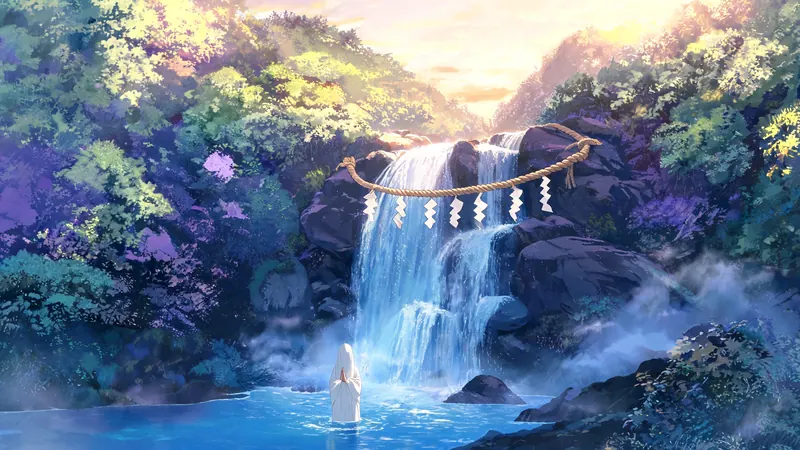
Back in the world of the living, he washes himself in a river to rid himself of the impurity of death. That ritual bath is the origin of misogi, Shintō's purification with water, which I describe in its own article. As Izanagi washes, kami are born from his body. According to the Kojiki, the three most precious come last. From his left eye Amaterasu, the kami of the sun. From his right eye Tsukuyomi, the kami of the moon. From his nose Susanoo, the kami of storm and sea.
Izanagi gives the sun the high plain of heaven to rule, the moon the realm of night, and Susanoo the sea. Two of the three accept. Susanoo cries and rages until mountains wither and rivers dry up, because he wants to go to his dead mother.
Tsukuyomi: why sun and moon never meet
The moon kami appears in only a few episodes, but one of them is memorable. In a version in the Nihon Shoki, Tsukuyomi visits the kami of food, Ukemochi, who produces a feast from her mouth: rice, fish and game. Disgusted, Tsukuyomi kills her. When Amaterasu hears of it, she says she never wants to see him again. Since then sun and moon live apart, one by day and one by night.
So in the myth Tsukuyomi is linked to separation and to night, which fits an illusion technique surprisingly well.
Amaterasu hides, and the world goes dark
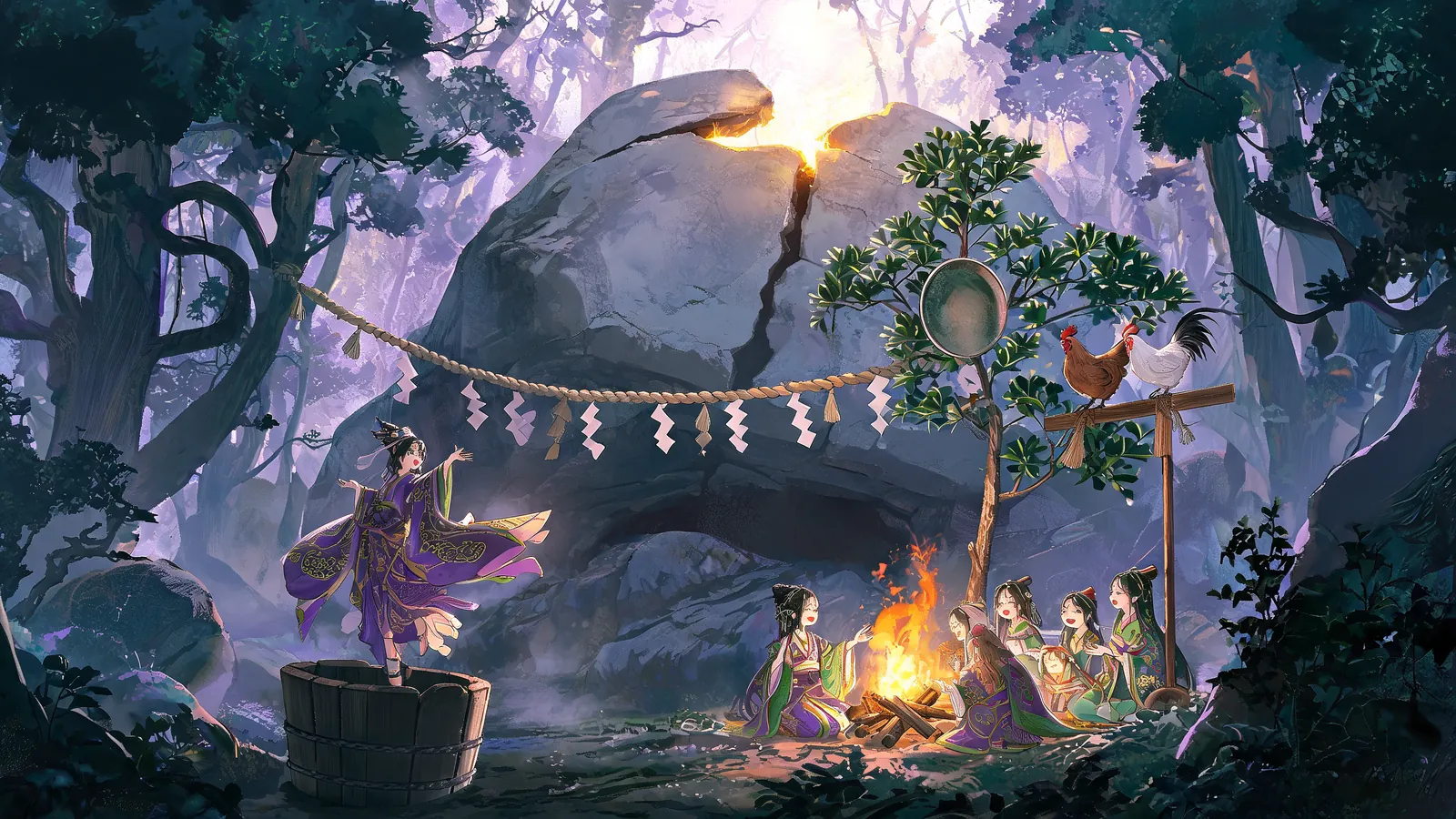
Before leaving heaven, Susanoo visits his sister. Things go badly. He destroys her rice fields, defiles her hall, and finally throws a flayed horse through the roof of her weaving hall. Amaterasu withdraws into a rock cave, Ama-no-Iwato, and closes it with a boulder. The sun disappears, and the world falls into darkness.
The other kami gather in front of the cave. They hang a mirror and jewels on a sacred tree, set roosters crowing, and the kami Ame-no-Uzume dances on an upturned tub so wildly that everyone bursts out laughing. Curious, Amaterasu opens the cave a crack. They show her the mirror, she leans out to see the bright figure in it, the strong kami Ame-no-Tajikarao pulls her out, and a straw rope is stretched across the cave so she can't go back in. Light returns. The mirror is the Yata no Kagami, the rope the first shimenawa, and the dance is remembered as the origin of kagura.
Susanoo and the eight-headed serpent
Susanoo is punished, his beard and nails are cut, and he's banished from heaven. He comes down in Izumo, on the Sea of Japan, and there the troublemaker becomes a hero. He meets an old couple weeping, because a serpent with eight heads and eight tails, Yamata-no-Orochi, has eaten seven of their eight daughters and is coming for the last one, Kushinadahime.
Susanoo has eight vats of strong sake brewed. The serpent drinks, one head per vat, and falls asleep. Susanoo cuts it to pieces with his sword. When his blade strikes something hard in one of the tails, he finds a second sword inside, which he gives to his sister. This sword became known as Kusanagi no Tsurugi, the grass-cutting sword. Then he marries Kushinadahime, builds a palace in Izumo and composes the first Japanese poem, about the eightfold clouds rising there.
What Naruto borrowed
Here's the detail I like best. In Naruto, Itachi's Susanoo carries the Totsuka Blade and the Yata Mirror. Both are real names from the myth. Totsuka no tsurugi (十拳剣), the "sword of ten fists' length," is the sword Susanoo used to cut the serpent. And the Yata mirror is the mirror from the rock cave. Kishimoto gave the storm kami the sword of his greatest deed and the mirror of his sister's return, which is a clever piece of mythological homework.
The black flames are a twist of their own. In the myth, Amaterasu is the opposite of darkness. If anything, her story is about what happens when the light withdraws.
Where the three kami live today
- Ise Jingū, Mie. The Inner Shrine is dedicated to Amaterasu and holds the sacred mirror. Tsukuyomi has his own shrines nearby, Tsukiyomi-no-miya.
- Amano Iwato Shrine, Takachiho. A shrine facing the cave said to be Amaterasu's hiding place, and a riverside grotto where visitors have stacked countless small stones.
- Izumo, Shimane. Susanoo's country. Suga Shrine claims to stand where he built his palace and wrote his poem, and the Iwami kagura performs the serpent fight with huge dragon costumes.
- Yasaka Shrine, Kyoto. Dedicated to Susanoo, the heart of the Gion festival.
- Atsuta Jingū, Nagoya. Where the sword Kusanagi is said to be kept. Nobody gets to see it.
If you could have one of the three Sacred Treasures, the mirror, the sword or the jewel, which would it be?
The Japanese Grimoire Society
The old myths and the places where they still live are a big part of the Japanese Grimoire Society, with the sources at hand and people who love the anime as much as you do. You can start with a free trial.
Have a look insideQuick answers
Who is Amaterasu in Japanese mythology?
Amaterasu Ōmikami is the kami of the sun, born from the left eye of the creator kami Izanagi when he purified himself after returning from the land of the dead. She is honored at the Inner Shrine of Ise and regarded as the ancestor of the imperial house.
Who is Susanoo?
Susanoo is Amaterasu's younger brother, a storm kami born from Izanagi's nose. After his rampage in heaven he was banished, went to Izumo, slew the eight-headed serpent Yamata-no-Orochi and found the sword Kusanagi in its tail.
Are the Totsuka sword and Yata mirror real?
Both come from Japanese myth. Totsuka no tsurugi, the 'ten-fist sword,' is the sword Susanoo used to slay the serpent. The Yata mirror is the sacred mirror used to lure Amaterasu out of the rock cave, one of the Three Sacred Treasures of the imperial regalia.
Sources and further reading
- Kojiki (712), book one; English translation by Donald L. Philippi, Kojiki, University of Tokyo Press, 1968.
- Nihon Shoki (720), books one and two; W. G. Aston, Nihongi, 1896.
- Ise Jingū, Izumo Taisha, Atsuta Jingū and Amano Iwato Jinja, official information.
Dr. Mark Hosak
Japanologist with a PhD from Heidelberg University and about three years of research at Kyoto University on Buddhist art, architecture and ritual. Shingon practitioner and researcher, successor of Taguchi Sensei in his line of Ninjutsu, author of books on Reiki and its Japanese roots. He walked all 88 temples of the Shikoku pilgrimage on foot.