Japanese Mythology: A Beginner's Map of Gods, Spirits and Sacred Stories
You've met Japanese kami in Naruto, Noragami, Ōkami and Spirited Away, usually without an introduction. Here's the map: where the stories come from, how they hang together, and where they're still told today.
Japanese mythology can feel like walking into the middle of a long family saga. Everyone seems to know who is whose sister, why one kami is sulking in a cave and why another one is fighting a serpent. Anime and games throw these names at you all the time and rarely stop to explain. So here's a rough map, the way I'd sketch it on a napkin for a friend.
Where the stories come from
Almost everything starts with two books. The Kojiki (古事記), the "Record of Ancient Matters," was completed in 712. The Nihon Shoki (日本書紀), the "Chronicles of Japan," followed in 720. Both were compiled at the imperial court, and both tell the story from the creation of the world down to the early emperors. The Nihon Shoki often gives several versions of the same episode side by side, introduced with "one writing says," which I find very honest of its editors.
Around the same time, the provinces were asked to write down their local lore in gazetteers called fudoki. Only a few survive, but they preserve stories the court chronicles leave out, like the founding legend of Inari that I tell in the article on Fushimi Inari.
The eight million kami
The powers of Japanese myth are called kami (神). The usual translation is "gods," but the word is broader than that. A kami can be a figure with a name and a story, like the sun kami Amaterasu. It can also be the power of a mountain, a waterfall, a great tree or a rock, a deified hero or scholar, or the protector of a single village. Japan speaks of yaoyorozu no kami, the "eight million kami," which simply means countless. Put simply, anything that inspires awe can be a kami.
Chapter one: creation
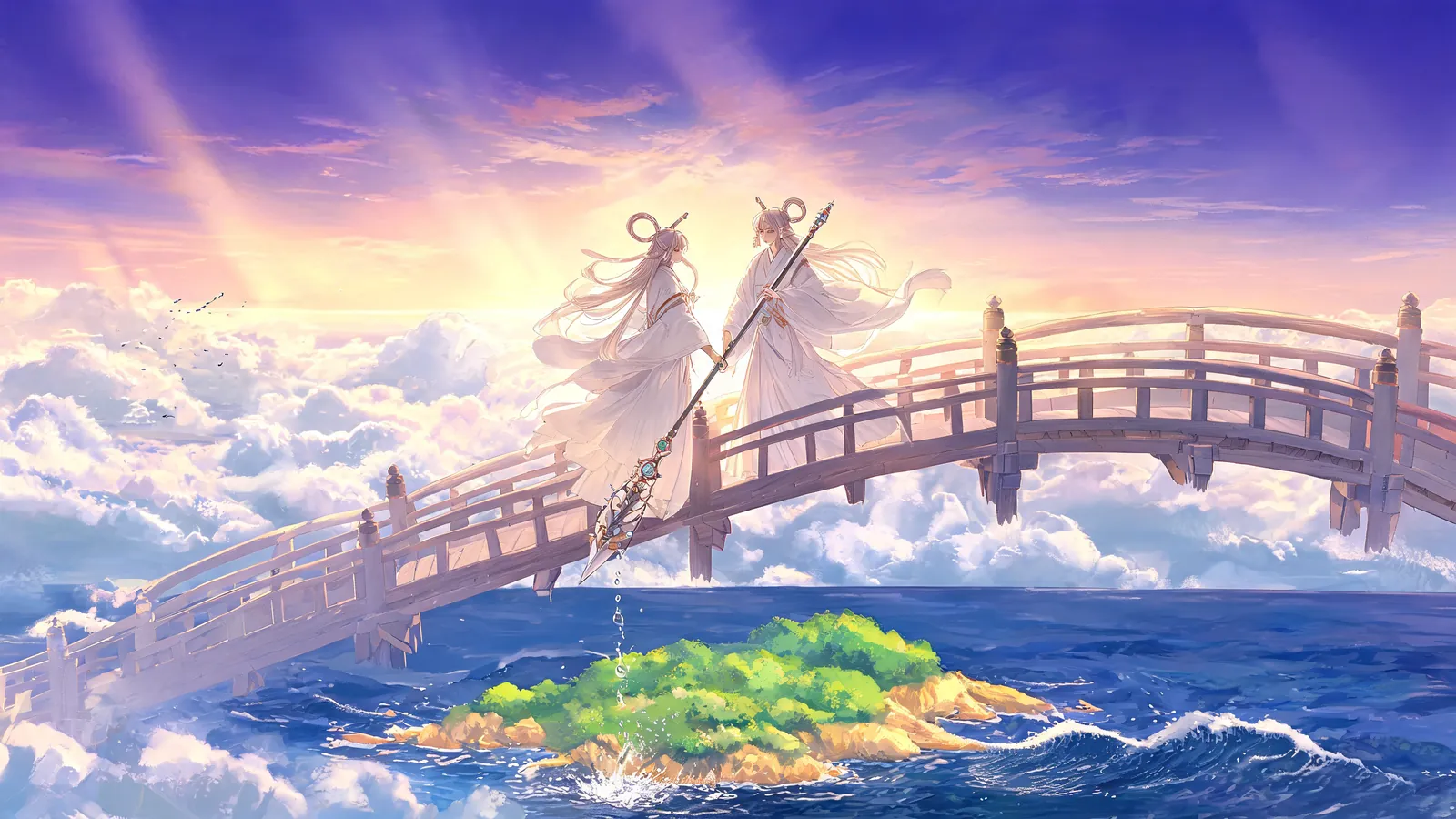
At the beginning, heaven and earth separate, and a series of kami appear on the high plain of heaven, Takamagahara. The last of them are a pair, Izanagi and Izanami. Standing on the floating bridge of heaven, they stir the ocean below with a jeweled spear. Drops fall from its tip and form the first island. They descend, marry, and give birth to the islands of Japan and to many kami of nature.
Then tragedy strikes. Izanami dies giving birth to the kami of fire and goes to Yomi, the land of the dead. Izanagi follows her, breaks his promise not to look at her, sees her decaying body and flees, chased by the hags of the underworld. At the border he blocks the passage with a boulder. Izanami calls out that she will kill a thousand people a day. Izanagi answers that he will cause fifteen hundred to be born. That's the myth's explanation for life and death.
Chapter two: sun, moon and storm
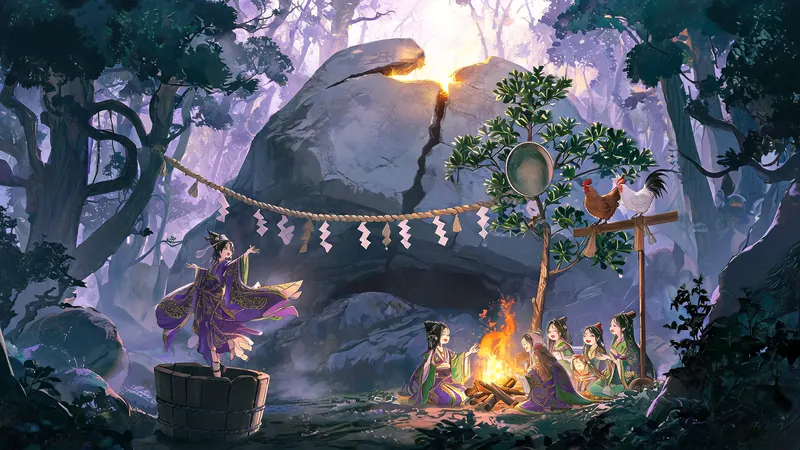
To cleanse himself of death, Izanagi bathes in a river, the origin of Shintō purification with water. From his face the three noble children are born: Amaterasu, the sun, Tsukuyomi, the moon, and Susanoo, the storm. Their quarrel leads to the most famous scene in Japanese myth, the sun hiding in a rock cave until a wild dance and a mirror bring her out again. I tell that whole part, including Susanoo's fight with the eight-headed serpent, in the article on Amaterasu and Susanoo.
Chapter three: Izumo and the white hare
The next cycle of stories takes place in Izumo, on the coast of the Sea of Japan. Its hero is Ōkuninushi, a descendant of Susanoo and the great kami of the land, of medicine and of good relationships. One of the best-loved episodes is the white hare of Inaba. A hare tricks a row of crocodiles, or sharks depending on how you translate the word, into forming a bridge across the sea so it can count them. At the last moment it boasts of the trick, and the last one in line skins it. Ōkuninushi's spiteful brothers advise the hare to bathe in salt water and dry in the wind, which makes things far worse. Ōkuninushi tells it to wash in fresh water and roll in cattail pollen, and the hare recovers. In return the hare predicts that Ōkuninushi will win the princess his brothers are courting. He does, and his brothers try to kill him for it, more than once.
Eventually Ōkuninushi hands over rule of the land to the descendants of Amaterasu, in an episode called the "transfer of the land." In exchange he receives a great shrine of his own. That shrine is Izumo Taisha, and it's still one of the most important shrines in Japan.
Chapter four: the descent from heaven
Amaterasu sends her grandson Ninigi down to rule the islands. He descends onto a mountain peak called Takachiho in southern Kyushu, a name two different places proudly claim, and brings three treasures with him: the mirror, the sword and the jewel. These are the Three Sacred Treasures, still the regalia of the Japanese emperor. Ninigi's great-grandson becomes Jimmu, the legendary first emperor, who marches east through the mountains guided by the three-legged crow Yatagarasu. You may know that crow from the emblem of the Japan Football Association.
Then the buddhas arrive
Buddhism reached Japan in the sixth century, and here a principle that runs through all of Japanese culture comes in. The old is rarely thrown away when something new arrives. It lives on next to it and slowly blends in. For more than a thousand years kami and buddhas were worshipped together, often in the same compounds. A widely held medieval theory explained the kami as local manifestations of buddhas and bodhisattvas, so that, for example, the sun kami was linked with Dainichi Nyorai, the great sun buddha of esoteric Buddhism. The government separated the two officially in 1868, but walk through any old temple or shrine and you'll still find traces of their long marriage.
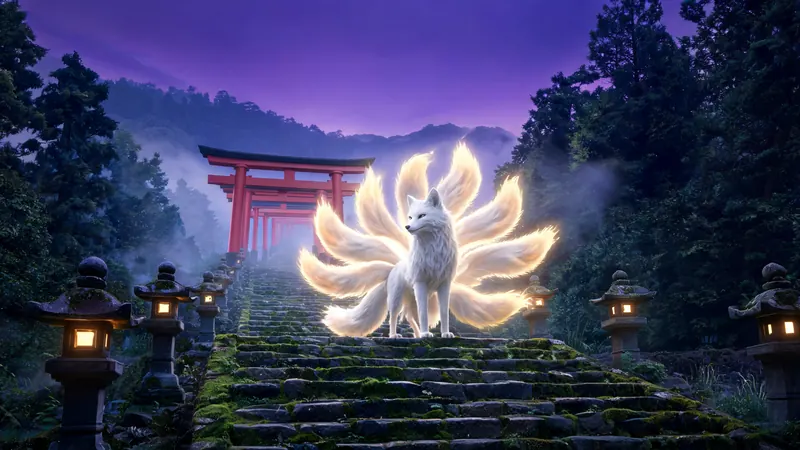
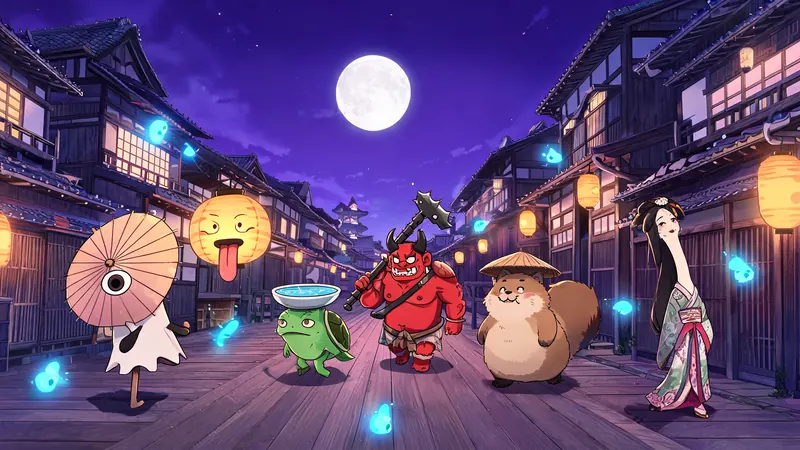
Mythology didn't stop there either. Folk religion added foxes, tengu, oni and a whole crowd of yokai, which I've collected in the yokai list.
Where you can visit the myths
- Izumo Taisha, Shimane. Ōkuninushi's shrine. In the tenth month of the old calendar the kami from all over Japan are said to gather here, which is why that month is called "the month without kami" everywhere else and "the month with kami" in Izumo.
- Hakuto Shrine, Tottori. The shrine of the white hare, on the coast where the story is set.
- Yomotsu Hirasaka, near Matsue. A quiet place in the woods with large stones, said to mark the border to the land of the dead.
- Takachiho, Miyazaki. The rock cave of Amaterasu and the region of Ninigi's descent.
- Ise Jingū, Mie. The shrine of Amaterasu and the sacred mirror.
Which part of the story would you most like to see as an anime of its own?
The Energy Between Your Hands
If you'd like to keep exploring Japan's myths and spirits, leave your email. You'll get a short practice from the Japanese tradition as a free PDF, and a few letters from me about the real tradition behind the anime.
Free. Unsubscribe anytime. Privacy policy
Quick answers
What are the main sources of Japanese mythology?
The two oldest chronicles, the Kojiki (712) and the Nihon Shoki (720), together with the regional gazetteers called fudoki from the same period. Later legends, shrine traditions and Buddhist tales added a great deal more.
What is a kami?
Kami (神) are the powers worshipped in Shintō. They can be ancestors of the imperial house, forces of nature, mountains, rivers, great trees, deified humans or local protectors. Japan speaks of 'eight million kami,' meaning countless.
Who created Japan in mythology?
According to the Kojiki and Nihon Shoki, the divine pair Izanagi and Izanami stirred the ocean with a jeweled spear from the floating bridge of heaven. The drops formed the first island, and the two then gave birth to the islands of Japan and to many kami.
Are Japanese kami and buddhas the same?
They are different, but for more than a thousand years they were worshipped together. A widespread medieval theory saw kami as local manifestations of buddhas and bodhisattvas. The two were officially separated in 1868, but the connection is still visible in many places.
Sources and further reading
- Kojiki (712); Donald L. Philippi (trans.), Kojiki, University of Tokyo Press, 1968.
- Nihon Shoki (720); W. G. Aston (trans.), Nihongi, 1896.
- Kokugakuin University, Encyclopedia of Shinto.
Dr. Mark Hosak
Japanologist with a PhD from Heidelberg University and about three years of research at Kyoto University on Buddhist art, architecture and ritual. Shingon practitioner and researcher, successor of Taguchi Sensei in his line of Ninjutsu, author of books on Reiki and its Japanese roots. He walked all 88 temples of the Shikoku pilgrimage on foot.