Kitsune Masks: Meaning and Use at Shrines and Festivals
You've seen the white fox masks on Urokodaki's students in Demon Slayer and hanging at every summer festival in anime. In Japan they're worn for fox weddings, New Year's processions and theater, and they've always been about crossing a boundary.
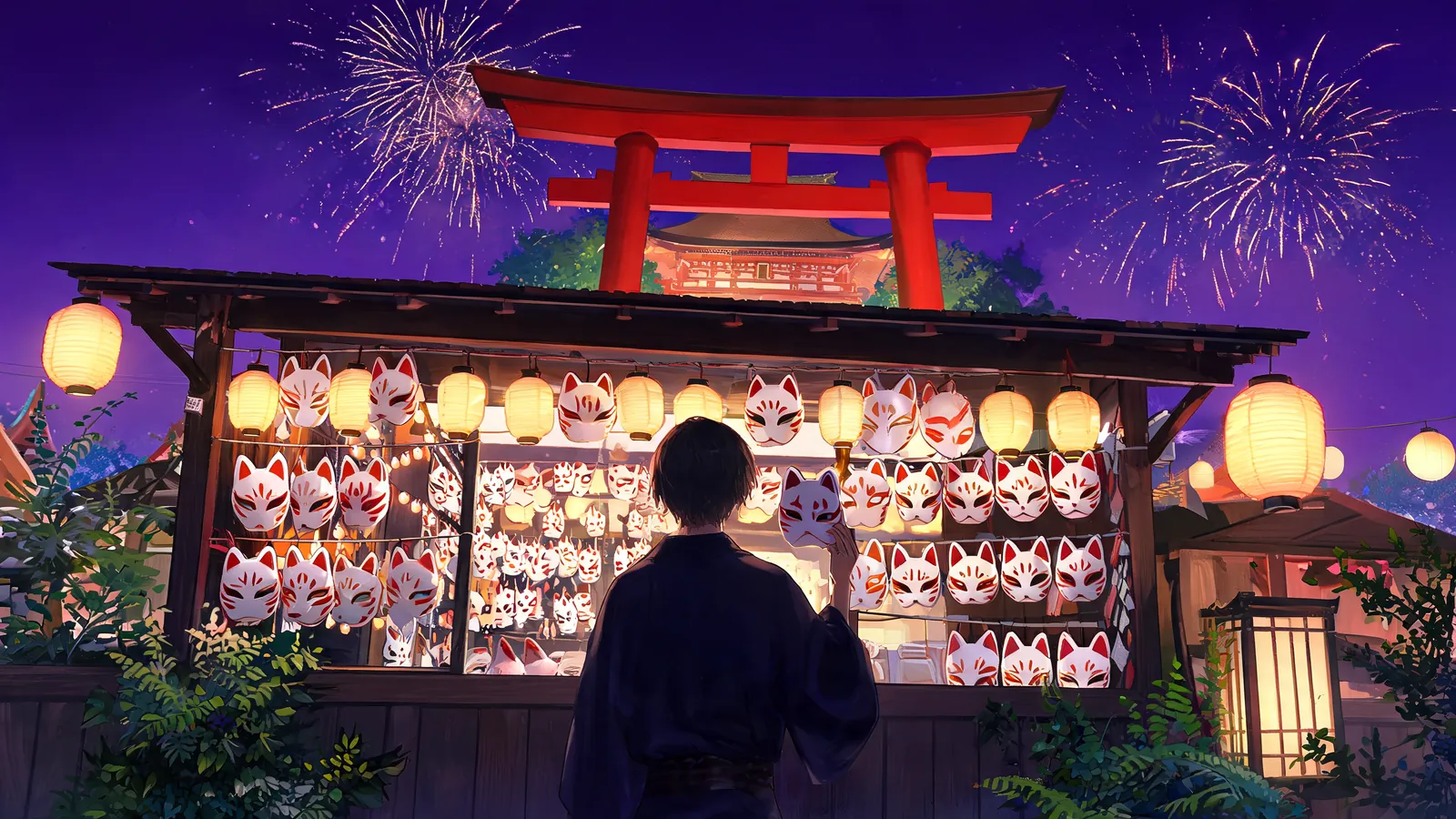
A white face, narrow eyes, red lines like flames around them, sometimes a bit of gold. The fox mask is one of the most recognizable images of Japan, and in anime it's practically a shortcut for "something mysterious is about to happen." In Japan it's simply part of festival life. But the reason people put it on is older and more interesting than decoration.
The fox between worlds
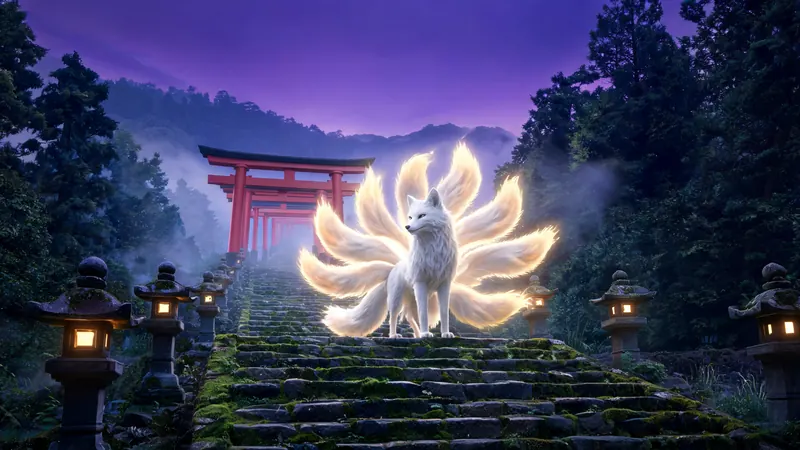
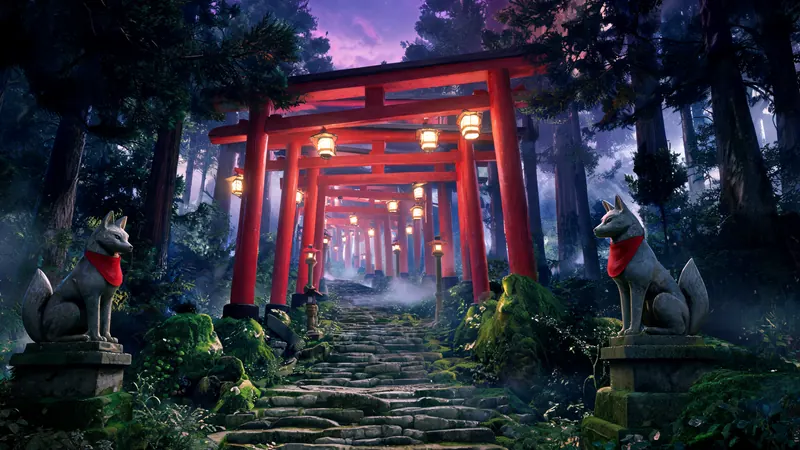
To understand the mask, you have to understand the fox. In Japanese belief the fox has two faces. It's the messenger of the kami Inari, guarding shrines in stone with a key or a jewel in its mouth. And it's the shape-shifter of folklore, the clever trickster who takes human form. Inari itself isn't a fox, by the way, a common mistake I explain in the article on the nine-tailed fox.
What both kinds of fox share is that they move between worlds, between the fields and the village, between humans and kami, between night and day. Put simply, the fox is a being of the threshold. When you put on a fox mask, you borrow that quality for a while.
What the mask does
Masks in Japan have always done more than hide a face. In ritual dances and in theater, a performer who puts on a mask is understood to take on the character or the being it shows. In festivals, wearing a mask lets ordinary people step out of their everyday role. The shopkeeper and the schoolgirl become foxes for an evening, and the usual rules relax a little. That's exactly why masks belong to festivals, the times of the year when the boundary between the human world and the world of the kami is thought to be open.
Fox weddings and foxfires
Two old folk images explain a lot of today's fox-mask customs.
The first is kitsune no yomeiri (狐の嫁入り), the fox's wedding. People told of mysterious rows of lights seen in the hills at night and explained them as a procession of foxes escorting a bride. In Japanese the same phrase also means a sunshower, rain falling from a clear sky, because the foxes were said to hold their weddings when the weather played tricks. In Tsugawa, in Niigata Prefecture, the town has turned the legend into a spring festival, with a fox wedding procession of people in fox makeup walking through the town and across the river at dusk.
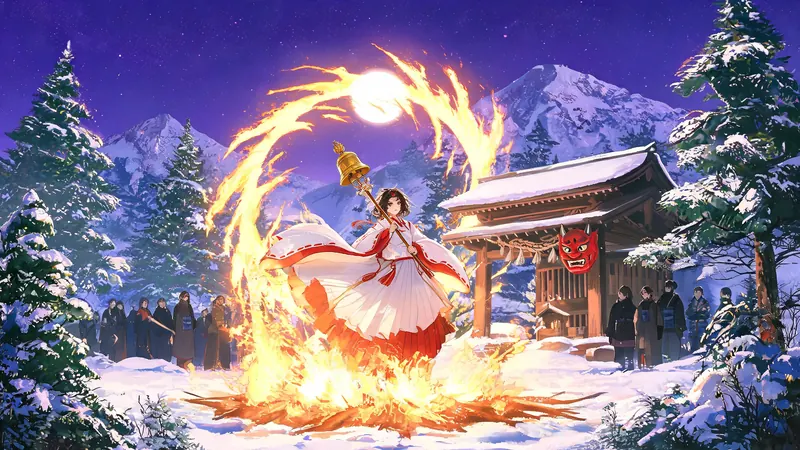
The second is the foxfire of Ōji in Tokyo. According to Edo-period legend, on New Year's Eve the foxes of the whole Kantō region gathered under a great tree near Ōji Inari Shrine, dressed in their finest, before paying their respects to the shrine. Farmers counted their ghostly fires to predict the coming harvest. The woodblock artist Hiroshige made a famous print of the scene in 1857. Since the 1990s, the neighborhood holds a fox procession every New Year's Eve, with hundreds of people in fox masks and fox makeup walking to the shrine at midnight. It's one of the most memorable ways to spend the last night of the year in Tokyo.
Foxes on stage
The fox also has a long life in theater. In the kyōgen comedy Tsurigitsune, an old fox disguises himself as a priest to talk a hunter out of trapping foxes, and it's considered one of the most demanding roles of the repertoire. In kabuki, fox characters often jump, twist and move in a way no human would, which is half the fun. Some kagura dances at shrines also include fox masks, especially in Inari rites.
The festival stall
The fox mask most visitors take home comes from a festival stall. At summer festivals and shrine fairs you'll find a booth hung with masks: foxes, hyottoko and okame with their round comic faces, tengu with long red noses, and nowadays a fair number of anime characters. Traditional masks are made of papier-mâché or wood and painted by hand, and the shops around Fushimi Inari in Kyoto sell them all year round. There's no single correct design. The red lines, the gold and sometimes a small flame or jewel on the forehead vary from maker to maker.
Demon Slayer's fox masks
In Demon Slayer, the old master Urokodaki carves a fox mask for each of his students as a charm against misfortune. Tanjiro receives one too. It's a lovely detail, because it combines two real Japanese ideas: masks as protection, and the fox as a being who stands between worlds and watches over those who cross. More on the real Japan behind that series in the article on Demon Slayer.
In May 2027 Eileen and I travel to Japan with a small group. Everything about the Spiritual Journey to Japan is on the Japan page of shingon-reiki.com.
Where you can see fox masks today
- Ōji Inari Shrine, Tokyo, on New Year's Eve. The fox procession at midnight.
- Tsugawa, Niigata, in spring. The fox wedding procession by the river.
- Fushimi Inari Taisha, Kyoto. Mask shops along the approach, and fox-face votive tablets to draw on.
- Any summer festival. Look for the mask stall between the goldfish scooping and the shaved ice.
If you wore a fox mask for one night, where would you go?
The Japanese Grimoire Society
Foxes, masks and the festivals where people cross into the world of the kami are part of what we explore in the Japanese Grimoire Society. You can start with a free trial and look around.
Have a look insideQuick answers
What does a kitsune mask mean?
A kitsune mask (狐面, kitsune-men) represents the fox, the messenger of the kami Inari and a shape-shifter of folklore. Wearing it at festivals and rites lets a person take on the role of a fox and step briefly out of everyday identity into the world between humans and kami.
Is it disrespectful to wear a kitsune mask?
Not in general. Fox masks are sold at shrines and festival stalls and worn by Japanese visitors too. As with any sacred symbol, wearing it with a little awareness of what it means is the respectful choice.
What is a fox wedding?
Kitsune no yomeiri, the fox's wedding, is a folk image of a procession of foxes carrying lanterns at night. The phrase also means a sunshower. Some towns, such as Tsugawa in Niigata, hold fox-wedding parades in which people wear fox makeup or masks.
Why do the characters in Demon Slayer wear fox masks?
In the story, the old master Urokodaki carves fox masks for his students as protective charms. The idea draws on the Japanese use of masks to ward off harm and on the fox as a being between worlds.
Sources and further reading
- Ōji Inari Jinja and the Ōji Kitsune no Gyōretsu committee (Tokyo), information on the New Year's Eve fox parade; Utagawa Hiroshige, New Year's Eve Foxfires at the Changing Tree, Ōji, from One Hundred Famous Views of Edo (1857).
- Aga Town (Niigata), information on the Tsugawa fox wedding procession.
- Karen A. Smyers, The Fox and the Jewel, University of Hawai'i Press, 1999.

Dr. Mark Hosak
Japanologist with a PhD from Heidelberg University and about three years of research at Kyoto University on Buddhist art, architecture and ritual. Shingon practitioner and researcher, successor of Taguchi Sensei in his line of Ninjutsu, author of books on Reiki and its Japanese roots. He walked all 88 temples of the Shikoku pilgrimage on foot.