Kumano Kodo: The Spiritual Pilgrimage Beyond the Hiking Guide
You've seen the mossy stone steps and the giant torii on travel feeds. The Kumano Kodo is more than a beautiful hike. For a thousand years people walked it to die symbolically and come back reborn.
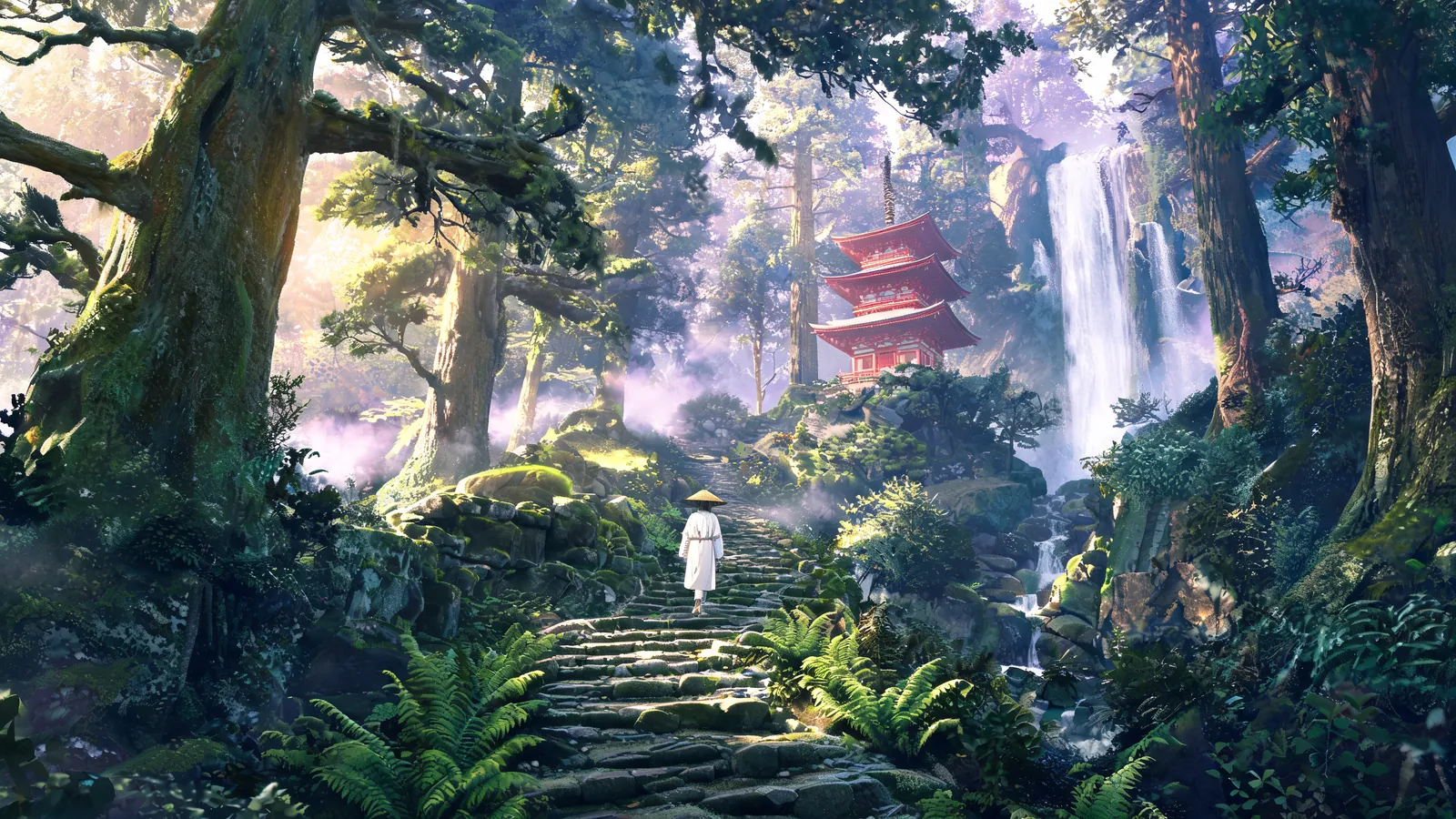
Most guides to the Kumano Kodo tell you about trail markers, luggage transfer and which inn has the best hot spring. All useful. But the people who wore these stones smooth over a thousand years weren't hiking. They were walking toward the edge of the world, and they expected to come back as someone else.
Kumano, the land at the edge
Kumano lies at the southern tip of the Kii Peninsula, south of Osaka and Nara, a region of steep mountains, dense forests, deep river valleys and a wild coast facing the Pacific. In early Japan it was seen as a remote, mysterious land close to the world of the dead. One version in the Nihon Shoki says that Izanami, the mother of the islands, was buried here.
That's the key to understanding the pilgrimage. Going to Kumano was a symbolic death. You left your ordinary life, crossed mountains and rivers, purified yourself, reached the shrines, and returned reborn. The modern hiker who says they "came back a different person" is, without knowing it, describing exactly what the tradition intended.
Three shrines and three buddhas
At the center are three grand shrines, together called Kumano Sanzan (熊野三山):
- Kumano Hongū Taisha, deep in the mountains on the Kumano River.
- Kumano Hayatama Taisha in Shingū, near the river mouth.
- Kumano Nachi Taisha, high above the coast next to Nachi Falls and the temple Seiganto-ji.
For most of Japanese history, kami and buddhas were worshipped together, and Kumano is one of the clearest examples. The main kami of the three shrines were understood as local manifestations of three buddhas: Amida, the buddha of infinite light, at Hongū, Yakushi, the Medicine Buddha, at Hayatama, and Senju Kannon, the thousand-armed bodhisattva of compassion, at Nachi. In other words, a pilgrim visited the Pure Land of the west, the buddha of the east and the compassion of Kannon in a single pilgrimage. The mountain ascetics of Shugendō made Kumano one end of their great trail through the Ōmine range, which I describe in the article on Shugendō.
Emperors in straw sandals
From the late Heian period on, retired emperors made the long trip from Kyoto to Kumano again and again, with huge retinues. Go-Shirakawa is said to have gone more than thirty times. Nobles followed, then warriors, then ordinary people in such numbers that the stream of pilgrims was compared to a line of ants, ari no Kumano-mōde.
Along the way they stopped at small shrines called ōji, the "princes," traditionally counted as ninety-nine, where they made offerings and sometimes held poetry gatherings. Many of them still stand along the trail. The last one before Hongū is Haraido Ōji, whose name means the place of purification. Pilgrims cleansed themselves there in the river before stepping into the presence of the kami, the same idea I describe in the article on misogi. Only after that did they climb the final stone steps to the shrine. In a sense the whole walk was a long preparation for those last few minutes.
Open to everyone
Here's what I find most remarkable about Kumano. Many sacred places in old Japan were closed to some people: women at certain mountains, the sick, the poor, those considered impure. Kumano was known for welcoming everyone. Traveling nuns, the Kumano bikuni, wandered the country with painted mandalas of Kumano, explaining heaven and hell to anyone who would listen and inviting them to make the pilgrimage. The wandering monk Ippen, founder of one of the Pure Land schools, received his decisive revelation at Hongū in 1274.
The three-legged crow
The messenger of Kumano is the crow Yatagarasu, with three legs, who according to legend guided the first emperor Jimmu through these mountains. You'll see crows everywhere at the shrines. Kumano's famous talismans, the goō hōin, have characters drawn entirely out of little crows, and samurai once wrote their sworn oaths on their back. More about that in the article on ofuda.
Nachi Falls and the boats to paradise
Nachi Falls drops about 133 meters in a single fall, the highest in Japan. The waterfall itself is honored as a kami, and the view of the falls with the vermilion three-storied pagoda of Seiganto-ji in front of it is one of the most famous images of Japan.
Down on the coast, at the temple Fudarakusan-ji, there's a darker story. Believing that Kannon's paradise, Fudaraku, lay across the sea to the south, some monks over the centuries set out in small boats with no way to steer, sealed inside, carrying only a little food. None came back. It's a sobering reminder that for some people the pilgrimage to the edge of the world wasn't symbolic at all.
Walking it today
- Nakahechi. The classic imperial route from Tanabe to Hongū and on to Nachi, three to five days for most walkers, with old inns and hot springs on the way.
- Ōyunohara. The sandbank where Hongū stood until a flood in 1889, marked today by one of the largest torii in the world.
- Daimonzaka. The stone stairway through ancient cedars up to Nachi, beautiful even if you walk nothing else.
- The sister route. The Kumano Kodo and the Camino de Santiago in Spain are twinned, and pilgrims who walk both can receive a special certificate.
The main thing I'd recommend is to slow down. Stop at an ōji, listen to the river, and remember that you're walking a route that people walked to be reborn. If you walked to the edge of the world, what would you leave behind there?
The Energy Between Your Hands
If you'd like to hear about new articles on Japan's sacred places, and about the small-group trip to Japan in May 2027, leave your email. You'll get a short practice from the Japanese tradition as a free PDF.
Free. Unsubscribe anytime. Privacy policy
Quick answers
What is the Kumano Kodo?
A network of ancient pilgrimage trails on the Kii Peninsula south of Osaka, leading to the three grand shrines of Kumano: Hongū Taisha, Hayatama Taisha and Nachi Taisha. Together with Kōyasan and Yoshino-Ōmine, the routes are a UNESCO World Heritage site since 2004.
Why is Kumano sacred?
Kumano was seen as a land at the edge of the world, close to the realm of the dead. A pilgrimage there was understood as a symbolic death and rebirth. In the era when kami and buddhas were worshipped together, its three shrines were linked with Amida, Yakushi and Kannon.
How long does the Kumano Kodo take?
The most popular route, the Nakahechi, takes most walkers three to five days to reach Hongū and continue to Nachi. Many visitors walk shorter sections in a day.
Sources and further reading
- UNESCO World Heritage Centre, Sacred Sites and Pilgrimage Routes in the Kii Mountain Range (inscribed 2004).
- Kumano Hongū Taisha, Kumano Nachi Taisha and the Tanabe City Kumano Tourism Bureau, official information.
- Kokugakuin University, Encyclopedia of Shinto: Yatagarasu shinji at Kumano Hongū.
Dr. Mark Hosak
Japanologist with a PhD from Heidelberg University and about three years of research at Kyoto University on Buddhist art, architecture and ritual. Shingon practitioner and researcher, successor of Taguchi Sensei in his line of Ninjutsu, author of books on Reiki and its Japanese roots. He walked all 88 temples of the Shikoku pilgrimage on foot.