Shingon Buddhism and Kūkai: Japan's Esoteric Path in Plain English
You've seen its mudras, mantras and mandalas in anime without knowing the name. Shingon is the esoteric Buddhism that a young monk from Shikoku brought back from China in 806, and it shaped Japanese spirituality like nothing else.
A lot of what anime presents as "Japanese magic," the hand seals, the chanted syllables, the circles of buddhas and the flames of fierce guardian kings, comes from one tradition. Most viewers have never heard its name. It's called Shingon, and it's the tradition at the center of my own research and practice.
A young man who walked out of university
Kūkai (空海) was born in 774 in Sanuki, on the island of Shikoku, today's Kagawa Prefecture. The temple Zentsū-ji stands where his family home is said to have been. As a gifted young man he was sent to the government university in the capital to become an official. He left. In a short work written in his twenties he explained why: Confucian learning and Daoism had their merits, but he had found something deeper in Buddhism.
He spent the following years as a wandering ascetic in the mountains of Shikoku and elsewhere. In a cave at Cape Muroto, at the southern tip of Shikoku, he practiced a demanding mantra recitation devoted to Kokūzō, the bodhisattva of boundless wisdom, and according to his own account the morning star entered his mouth. The name he took, Kūkai, means "sky and sea," and tradition says that's what he saw from the mouth of that cave: nothing but sky and sea.
Two years in China
In 804 Kūkai sailed to China with an official embassy. In the capital, Chang'an, he met the master Huiguo, the leading teacher of esoteric Buddhism of his time, who, according to Kūkai's report, greeted him with the words that he had been waiting for him. Within a few months Huiguo initiated him into both of the great mandalas and passed the full transmission to him. Huiguo died that same winter.
Kūkai returned to Japan in 806 with sutras, mandalas, ritual implements and a knowledge of Sanskrit and of the Siddham script (Bonji in Japanese) that almost nobody else in Japan had. While in China he would also have met Daoist thought and practice, and I think it's very likely that he knew exactly how closely the two traditions touched each other there.
What "Shingon" means
Shingon (真言) means "true word." It's the Japanese translation of the Sanskrit mantra. The name tells you where the emphasis lies. Shingon teaches that the cosmic buddha, Dainichi Nyorai (大日如来), the great sun buddha, is preaching all the time, through every sound, form and movement in the universe. Esoteric practice is a way of learning to hear and answer that.
The answer happens through the three mysteries, sanmitsu: the body forms a mudra, the voice speaks a mantra, the mind visualizes a buddha or its seed syllable. When all three are aligned with those of a buddha, Kūkai taught, a person can become a buddha in this very body, sokushin jōbutsu (即身成仏). Put simply, you don't have to wait for countless future lives. I write more about the hand seals in the article on mudras.
Two great mandalas map this universe. The Womb Realm mandala shows the compassion of the buddhas unfolding like a lotus. The Diamond Realm mandala shows their indestructible wisdom. They hang facing each other in Shingon halls, and practitioners work with both.
Kōyasan and Tō-ji
In 816 the emperor granted Kūkai a high plateau in the mountains south of Nara, Mount Kōya, for a monastery. In 823 he received the temple Tō-ji in Kyoto as a center in the capital. Kūkai was also an engineer who repaired a huge irrigation reservoir in his home province, a poet, and one of the three great calligraphers of his age. In Japan there's a saying that even Kōbō makes mistakes with the brush. If he can, so can you.
He died on Kōyasan in 835. In 921 the court gave him the title Kōbō Daishi, "Great Master who spread the Dharma." According to Shingon belief he didn't die but entered eternal meditation, and to this day monks bring him meals twice a day in the inner sanctuary, Okunoin, at the end of a path through a cedar forest lined with more than two hundred thousand graves and memorials.
My own path with Shingon
I studied East Asian art history and Japanese studies in Heidelberg. In Kyoto, where I did research for about three years with two scholarships, I spent much of my time in temples. There I came across the original form of a Reiki symbol written in Siddham, which became the subject of my master's thesis and later of my dissertation.
My professor in Kyoto recommended that I walk the Shikoku pilgrimage, the 88 temples connected with Kūkai. On my first attempt I gave up after about ten days, at Temple 24. A year later I walked all 88. He also gave me a statue of the Medicine Buddha. I'm a Shingon practitioner and researcher, and that's the root from which my work with Shingon Reiki and Kuji Kiri grows.
Shingon Reiki Level 1 is a live event in English with five initiations, four Reiki initiations and the initiation into the Medicine Buddha. Details are on the Shingon Reiki Level 1 page.
Where you can meet Shingon today
- Kōyasan, Wakayama. Over a hundred temples on the mountain plateau, many offering overnight stays with vegetarian temple food and the morning service.
- Tō-ji, Kyoto. The five-storied pagoda and the lecture hall with its statue mandala.
- Zentsū-ji, Kagawa. Kūkai's birthplace, Temple 75 of the pilgrimage.
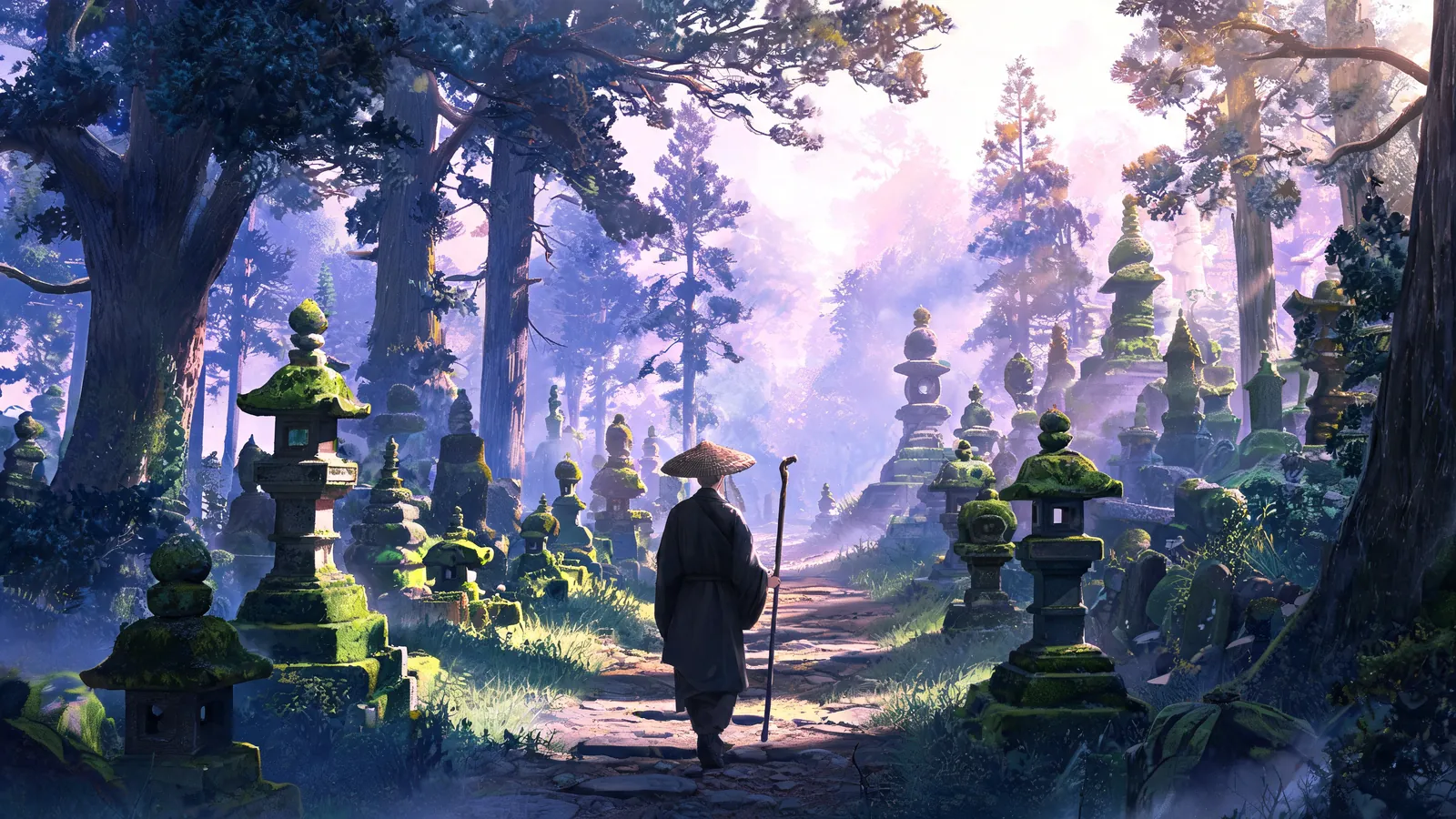
- The 88 temples of Shikoku. All around the island, walked by pilgrims in white with a straw hat and a staff that stands for Kūkai himself.
If you could ask Kūkai one question, what would it be?
The Japanese Grimoire Society
Shingon is one of the main roots of everything on this site. In the Japanese Grimoire Society we work with it from the sources up, together with the practice. You can start with a free trial.
Have a look insideQuick answers
What is Shingon Buddhism?
Shingon (真言), 'true word,' is the Japanese school of esoteric Buddhism (mikkyō) founded by Kūkai in the early ninth century. It works with mantras, mudras, mandalas and visualization, and teaches that one can become a buddha in this very body.
Who was Kūkai?
Kūkai (774–835), known after his death as Kōbō Daishi, was a monk from Sanuki on Shikoku who studied esoteric Buddhism in China, founded Shingon in Japan, built the monastery on Mount Kōya and received the temple Tō-ji in Kyoto. He is also revered as one of Japan's greatest calligraphers.
What is the difference between Shingon and Zen?
Both are Japanese forms of Buddhism. Zen emphasizes seated meditation and direct insight with very little ritual. Shingon is an esoteric tradition that works with the body, the voice and the mind together, through mudras, mantras and visualization of buddhas.
What is the Shikoku pilgrimage?
A circuit of 88 temples around the island of Shikoku, associated with Kūkai, about 1,200 kilometers long. Pilgrims walk it in white clothing, accompanied, according to tradition, by Kūkai himself.
Sources and further reading
- Yoshito S. Hakeda, Kūkai: Major Works, Columbia University Press, 1972.
- Ryūichi Abé, The Weaving of Mantra: Kūkai and the Construction of Esoteric Buddhist Discourse, Columbia University Press, 1999.
- Mark Hosak, chapters on esoteric Buddhism and Kūkai in The Big Book of Reiki Symbols: The Spiritual Transition of Symbols and Mantras of the Usui System of Natural Healing (Lotus Press).
Dr. Mark Hosak
Japanologist with a PhD from Heidelberg University and about three years of research at Kyoto University on Buddhist art, architecture and ritual. Shingon practitioner and researcher, successor of Taguchi Sensei in his line of Ninjutsu, author of books on Reiki and its Japanese roots. He walked all 88 temples of the Shikoku pilgrimage on foot.