Mount Kurama: Tengu, Sōjōbō and the Mountain Behind Reiki
You've heard the name from Naruto's fox and from every Reiki book. Kurama is a real range of mountains north of Kyoto, home of the great tengu, a being said to have come from Venus, and the place where Reiki began.
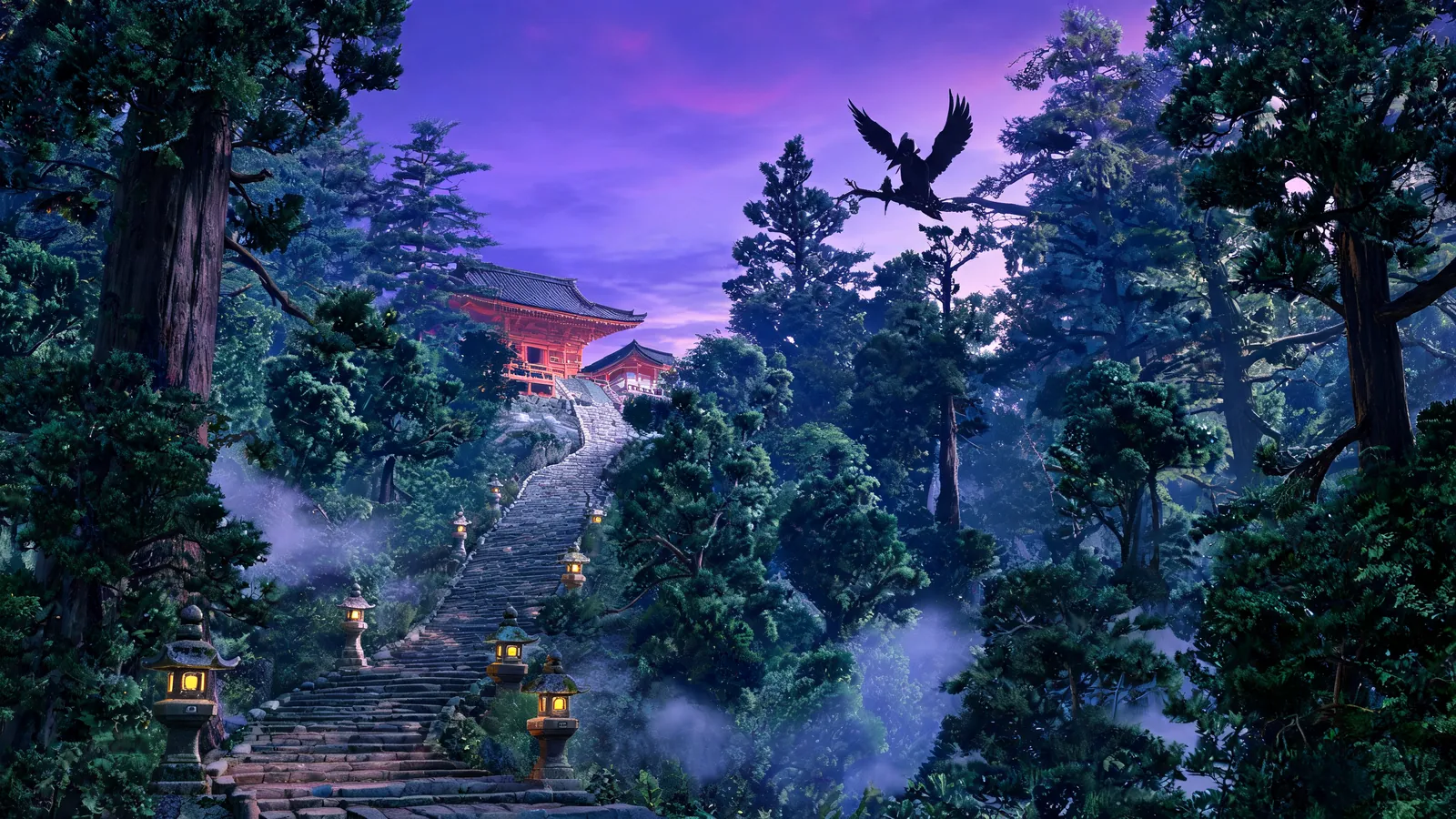
Fans of Naruto know Kurama as the name of the nine-tailed fox. Reiki practitioners know it as "the mountain where Usui meditated." Both are borrowing from a real place, a range of forested peaks north of Kyoto that had a reputation for strange encounters long before either of them. Let's take a walk up.
A saddle, not a single peak
The name is written 鞍馬, "horse saddle." That describes the landscape well. Kurama isn't one cone-shaped mountain. It's a group of peaks connected by gentle saddles, so you can move from one summit to the next without dropping deep into a valley. The highest point is only around 570 meters, but the slopes are steep and densely forested.
Japanese doesn't mark plural, so Kurama-yama can mean "Mount Kurama" or "the Kurama mountains." Most Western books chose the singular, and so a single mountain lives on in the West. When we talk about where Usui meditated, it's more accurate to think of a whole range with many places for practice: waterfalls, rocks, old trees, small shrines.
A place you didn't enter lightly
Kurama had a fearsome reputation in the Heian period. The Sarashina Nikki, a diary of the early eleventh century, says the mountain was so overgrown that even people who had decided to go there on pilgrimage were held back by fear. Tengu were believed to live there, and some of the old stories say they liked to hang monks upside down from trees. That doesn't sound very nice. The more earthly dangers haven't gone away either. Signs on the paths still warn of Japanese black bears and of the mamushi, a venomous snake.
Visions that founded a temple
The temple Kurama-dera goes back to two visions in the eighth century. According to its tradition, in 770 the monk Kantei, a disciple of the famous Chinese master Ganjin, was led up the mountain by a white horse and there had an encounter with Bishamonten, the protective being of the north. Twenty-six years later, in 796, a nobleman named Fujiwara no Isendo had a vision of Senju Kannon, the thousand-armed bodhisattva of compassion, in the same place, and expanded the temple.
Today Kurama-dera honors three spirits together, called Sonten (尊天): Senju Kannon for love, Bishamonten for light and Maōson for the power of life. The third is the most unusual. According to the temple's own tradition, Maōson came down to Kurama from Venus about six and a half million years ago to guide humanity. Yes, you read that right. Since 1949 the temple has been the head of its own independent school, Kurama Kōkyō.
Sōjōbō and the young Yoshitsune
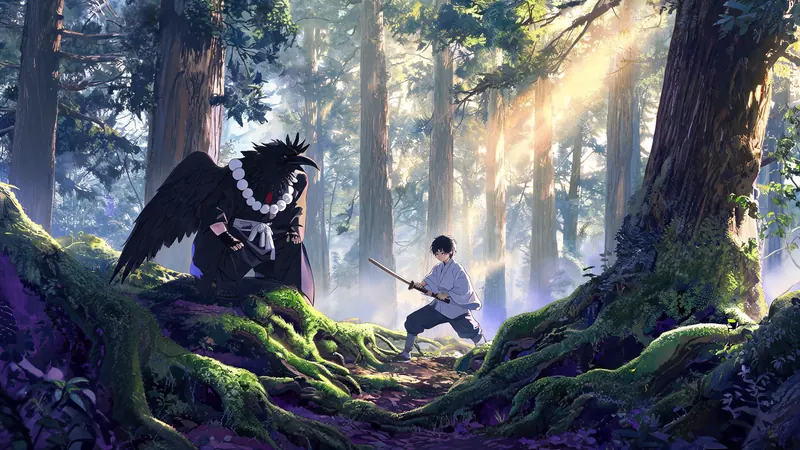
The great tengu of Kurama is Sōjōbō, often called the king of all tengu. Legend says he trained the boy Ushiwakamaru, the later Minamoto no Yoshitsune, in swordsmanship in the forests above the temple. I tell that story in detail in the article on tengu. On the path from Kurama-dera over the mountain you pass the spot where Yoshitsune is said to have practiced, among cedar roots that grow so thickly over the ground that you trip if you don't watch your feet. There's a small shrine for him nearby.
Usui's twenty-one days
In 1922 Mikao Usui, the founder of Reiki, went to Kurama to fast and meditate. According to the memorial stone erected for him in 1927, it was on the twenty-first day that he had the experience from which Reiki developed. Why this mountain? Japan has many sacred mountains. I think it's very likely that Usui chose Kurama because it had been known for centuries as a place of spiritual breakthroughs. Kantei and Isendo had their visions there, the mountain ascetics practiced there, and the ground, so to speak, was prepared.
Where exactly on the mountain Usui sat isn't documented. My own view is that it was most likely near the old cedars by the Yoshitsune shrine, a place with an unusual atmosphere that fits the descriptions well, but I want to be clear that this is my interpretation. What we know is that Reiki grew from roots that are much older than 1922: esoteric Buddhism, Shugendō, Shintō and shamanic Daoism. That's why I call my approach Shingon Reiki and why I keep going back to those sources.
Shingon Reiki Level 1 is a live event in English with five initiations, four Reiki initiations and the initiation into the Medicine Buddha. Details are on the Shingon Reiki Level 1 page.
Fire in October, water in Kibune
Every year on October 22, the village at the foot of the mountain holds the Kurama Fire Festival at Yuki Shrine. Young men carry huge burning torches through the narrow street at night, chanting, while the whole valley glows. It's one of the most dramatic festivals in Kyoto.
On the other side of the mountain lies Kibune, with Kibune Shrine, dedicated to a kami of water. In summer, restaurants there set up platforms over the cold river, and people eat dinner a few centimeters above the rushing water. Walking from Kurama over the mountain to Kibune, or the other way round, takes about two hours and is one of the most beautiful short hikes near Kyoto.
How to visit
- Getting there. The Eizan railway from Demachiyanagi in Kyoto takes about 30 minutes to Kurama station, which greets you with a giant tengu head.
- The climb. From the gate to the main hall is a steep walk of about 30 minutes, or a short cable car.
- Over the mountain. Continue past the inner sanctuary and the Yoshitsune sites down to Kibune.
- When. Autumn leaves in November, fresh green in May, and the fire festival on October 22 if you don't mind crowds.
If you could spend one night alone on Kurama, would you go looking for the tengu or stay in the temple?
The Energy Between Your Hands
If you'd like to hear about new articles on Japan's sacred places, and about the small-group trip to Japan in May 2027, leave your email. You'll get a short practice from the Japanese tradition as a free PDF.
Free. Unsubscribe anytime. Privacy policy
Quick answers
Where is Mount Kurama?
Kurama lies in the north of Kyoto city, about 12 kilometers from the old imperial palace. It's reached by the Eizan railway from Demachiyanagi in about 30 minutes. The highest point of the range is around 570 meters.
Why is Kurama important for Reiki?
According to the memorial stone of Mikao Usui, erected in 1927, Usui fasted and meditated for 21 days on Kurama and there received the experience from which Reiki developed.
Who is Sōjōbō?
Sōjōbō is the great tengu of Kurama, the king of the tengu in Japanese legend, who is said to have trained the young Minamoto no Yoshitsune in swordsmanship.
What is Maōson?
Maōson (魔王尊) is one of the three spirits honored together at Kurama-dera, together with Senju Kannon and Bishamonten. According to the temple's tradition he came to Kurama from Venus, millions of years ago.
Sources and further reading
- Kurama-dera (Kurama Kōkyō), temple information on its founding and on Sonten.
- Sarashina Nikki, early 11th century.
- Inscription of the Usui memorial stone (1927), Saihō-ji, Tokyo.
- Mark Hosak, chapter on the Kurama mountains in The Big Book of Reiki Symbols: The Spiritual Transition of Symbols and Mantras of the Usui System of Natural Healing (Lotus Press) and Reiki in der therapeutischen Praxis.
Dr. Mark Hosak
Japanologist with a PhD from Heidelberg University and about three years of research at Kyoto University on Buddhist art, architecture and ritual. Shingon practitioner and researcher, successor of Taguchi Sensei in his line of Ninjutsu, author of books on Reiki and its Japanese roots. He walked all 88 temples of the Shikoku pilgrimage on foot.